This is a blog where I post my favourite photographs from around the places I've visited. I am an amateur photographer and I am ever learning as I go along!
Thursday, 20 January 2022
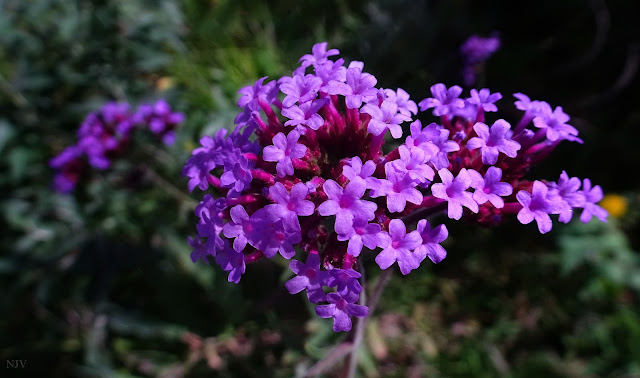
VERVAIN
Thursday, 19 August 2021
PERUVIAN LILY
Thursday, 17 June 2021
PANSY ORCHID
Miltonia, abbreviated Milt. in the horticultural trade, is an orchid genus formed by nine epiphyte species and eight natural hybrids inhabitants of the Brazilian Atlantic Forest, one species reaching the northeast of Argentina and east of Paraguay. This genus was established by John Lindley in 1837, when he described its type species, Miltonia spectabilis. Many species were attributed to Miltonia in the past, however, today, the species from Central America and from cooler areas on northwest of South America have been moved to other genera.
Miltonia species have large and long lasting flowers, often in multifloral inflorescences. This fact, allied to being species that are easy to grow and to identify, make them a favourite of orchid collectors all over the world. Species of this genus are extensively used to produce artificial hybrids. Despite the fact that Miltonia is now a well established genus, most of its species were originally classified under other genera as Cyrtochilum, Oncidium, Odontoglossum, and Brassia. All were discovered between 1834 and 1850 with the exception of M. kayasimae, discovered only in 1976.
These epiphytic orchids occur from Central to Southern Brazil down to Argentina. They are named after Charles Wentworth-Fitzwilliam, 5th Earl Fitzwilliam, formerly Viscount Milton, an English orchid enthusiast. These orchids have two leaves, arising from a pseudobulbs, covered with a foliaceous sheath. The inflorescence consists of waxy, nonspurred flowers. The lip is large and flat and lacks a callus at its base. They possess a footless column with two hard pollinia. The flowers have a delicate, exotic scent, some compare to that of roses. The species in this genus are sometimes referred to as the "pansy orchids", but it is the Miltoniopsis orchids that have flowers that closely resemble the pansy. Almost everyone except for the most serious orchid hobbyists use the name pansy orchids interchangeably, which may cause confusion.
This post is part of the Floral Friday Fotos meme.
Thursday, 22 April 2021
JACOBINIA
Thursday, 14 January 2021
TWEEDIA
Thursday, 16 July 2020
AMAZON LILY
Thursday, 4 June 2020
ANDEAN SAGE
Thursday, 30 April 2020
SPARROW IN RED
Thursday, 29 August 2019
SPRING STAR
Thursday, 16 May 2019
CATTLEYA
Thursday, 16 August 2018
FLAME TREE
Thursday, 15 February 2018
URN PLANT
The plant grows slowly, reaching 30–90 cm in height, with a spread of up to 60 cm. It has elliptic–oval-shaped leaves 45–90 cm long and arranged in a basal rosette pattern. A. fasciata requires partial shade and a well-drained, but moisture-retentive soil. It can also be grown epiphytically, as, for example, with moss around its roots and wired to rough bark. Root rot can be a problem if the soil is too moist. Scale insects and mosquitos will sometimes breed in the pools of water that are trapped between the leaves.
A. fasciata is listed in the FDA Poisonous Plant Database under the section for "Skin irritating substances in plants" and is known to cause contact dermatitis, phytophotodermatitis, and contact allergy.
This post is part of the Floral Friday Fotos meme.
Thursday, 16 November 2017
FEIJOA FLOWERS
Wednesday, 26 April 2017
SEA HOLLY
These are annual and perennial herbs with hairless and usually spiny leaves. The dome-shaped umbels of steely blue or white flowers have whorls of spiny basal bracts. Some species are native to rocky and coastal areas, but the majority are grassland plants. In the language of flowers, they represent "admiration".
Illustrated here is Eryngium x zabelii ‘Big Blue’, a common garden and cut flower. It produces especially large heads of steel-blue prickly flowers over a mound of silvery leaves that add texture to the sunny border. Exceptionally good for cutting, fresh or dried. Plants are mid-sized in habit with strong stems. A versatile plant, fitting well into the border and also useful in containers. Drought tolerant once established. Sea Holly is an easy-care perennial that adapts well to most sunny areas with average to dry soil. Remove old stems to ground level in late Autumn or early Spring.
This post is part of the Floral Friday Fotos meme.
Thursday, 19 January 2017
JACARANDA
The tree grows to a height of 5 to 15 meters. Its bark is thin and grey-brown in colour, smooth when the tree is young though it eventually becomes finely scaly. The twigs are slender and slightly zigzag; they are a light reddish-brown in colour. The flowers are up to 5 cm long, and are grouped in 30 cm panicles. They appear in spring and early summer, and last for up to two months. They are followed by woody seed pods, about 5 cm in diameter, which contain numerous flat, winged seeds. The Blue Jacaranda is cultivated even in areas where it rarely blooms, for the sake of its large compound leaves. These are up to 45 cm long and bi-pinnately compound, with leaflets little more than 1 cm long.
This post is part of the Floral Friday Fotos meme.
Thursday, 25 August 2016
PEPINO
The pepino dulce fruit resembles a melon (Cucumis melo) in colour, and its flavour recalls a mixture of honeydew and cucumber, and thus it is also sometimes called pepino melon or melon pear, but pepinos are only very distantly related to melons and pears. Another common name, "tree melon", is more often used for the Papaya (Carica papaya) though the pepino dulce plant generally does not look much like a tree; it looks more like a ground cover, trailing plant.
The present species is, however, a close relative of other nightshades cultivated for their fruit, including the tomato (S. lycopersicum) and the eggplant (S. melongena), which its own fruit closely resembles. Pepino fruit is common in markets in Colombia, Ecuador, Bolivia, Peru and Chile, but less often overseas because it is quite sensitive to handling and does not travel well. Attempts to produce commercial cultivars and to export the fruit have been made in New Zealand, Turkey, Mauritius and Chile.
This post is part of the Floral Friday Fotos meme,
and also part of the Friday Greens meme,
and also part of the Food Friday meme.
Thursday, 14 April 2016
MARVEL OF PERU
A curious aspect of this plant is that flowers of different colours can be found simultaneously on the same plant. Different colour variation in the flower and different colour flowers in same plant. Additionally, an individual flower can be splashed with different colours. Another interesting point is a colour-changing phenomenon. For example, in the yellow variety, as the plant matures, it can display flowers that gradually change to a dark pink colour. Similarly white flowers can change to light violet.
This post is part of the Floral Friday Fotos meme.
Thursday, 28 January 2016
URN PLANT
This post is part of the Floral Friday Fotos meme.
Friday, 10 April 2015
FRIDAY GREENS #15 - FEIJOA
It is an evergreen, perennial shrub or small tree, 1–7 metres in height, widely cultivated as an ornamental tree and for its fruit. The German botanist Otto Karl Berg named feijoa after João da Silva Feijó, a Portuguese botanist born in the colony of Brazil.
The fruit, maturing in autumn, is green, ellipsoid, and about the size of a chicken egg. It has a sweet, aromatic flavour, which tastes like pineapple, apple and mint. The flesh is juicy and is divided into a clear, gelatinous seed pulp and a firmer, slightly granular, opaque flesh nearer the skin. The fruit falls to the ground when ripe and at its fullest flavour, but it may be picked from the tree prior to falling to prevent bruising. Feijoa fruit has a distinctive, potent smell that resembles that of a perfume. The aroma is due to the ester methyl benzoate and related compounds that exist in the fruit. Personally, it reminds me of oil of wintergreen, which smell I do not like, hence it ruins the fruit for me...
Please add your own GREEN post using the Linky tool below:
Thursday, 5 February 2015
NEOREGELIA
They have mostly broad, relatively flat leaves. Inflorescences form in a shallow depression the centre of the plant, which often fills partway with water, through which the flowers bloom. Offsets form around the central flowering rosette. The leaves immediately surrounding the inflorescence are very often brightly coloured, and many species show banding or striping on most or all of their leaves.
Neoregelia Bromeliads are excellent plants and will adapt to many conditions, so in a warm setting they can be used as a indoor plant or outdoor landscape plant. Neoregelias are some of the most colourful epiphytes around and range from the common house plant varieties to the more rare exotic varieties such as the Neoregelia ‘Rafael’.
This post is part of the Floral Friday Fotos meme.


