Thursday, 3 November 2016

ABUTILON

Abutilon or Chinese lantern is closely related to Hibiscus, and most of the hundred or so species have pendulous, hibiscus-like flowers. Cultivars produced by hybridising some of the South American abutilons have all been placed in one group known as Abutilon x hybridum, and these are the ones most commonly grown in Australian gardens. They have a wispy, delicate form and colourful, lantern-shaped flowers. For gardeners who prefer plants with a more dense habit, new compact varieties are also available.

They are evergreen shrubs with attractive maple-like leaves and an open, pendulous habit. They grow to about 2-3 metres tall (or 50-100 cm if a compact variety). Flowers are produced in September to December, but they spot flower at other times. Flower colours include white, pink, red, yellow, orange and salmon. Abutilons grow well in most parts of Australia, except for the very cold mountain zones. In inland areas be sure to water well and keep protected with mulch. In hot inland climates abutilons appreciate some light shade.

A full sun position is best, but abutilons will also flower in part shade. They like a rich, well drained soil and a cool root run. Water well and mulch. Avoid heavy feeding as abutilons are inclined to produce foliage at the expense of flowers. Light prune to shape toward the end of winter in frost free gardens. Leave until early spring in frost-prone areas. They can become untidy and leggy like hibiscus. As abutilons are members of the Malvaceae family, they are also subject to attack by hibiscus beetle and metallic flea beetle. These pests make holes in leaves and flowers and are difficult to control with pesticides.

This post is part of the Floral Friday Fotos meme.


Wednesday, 2 November 2016

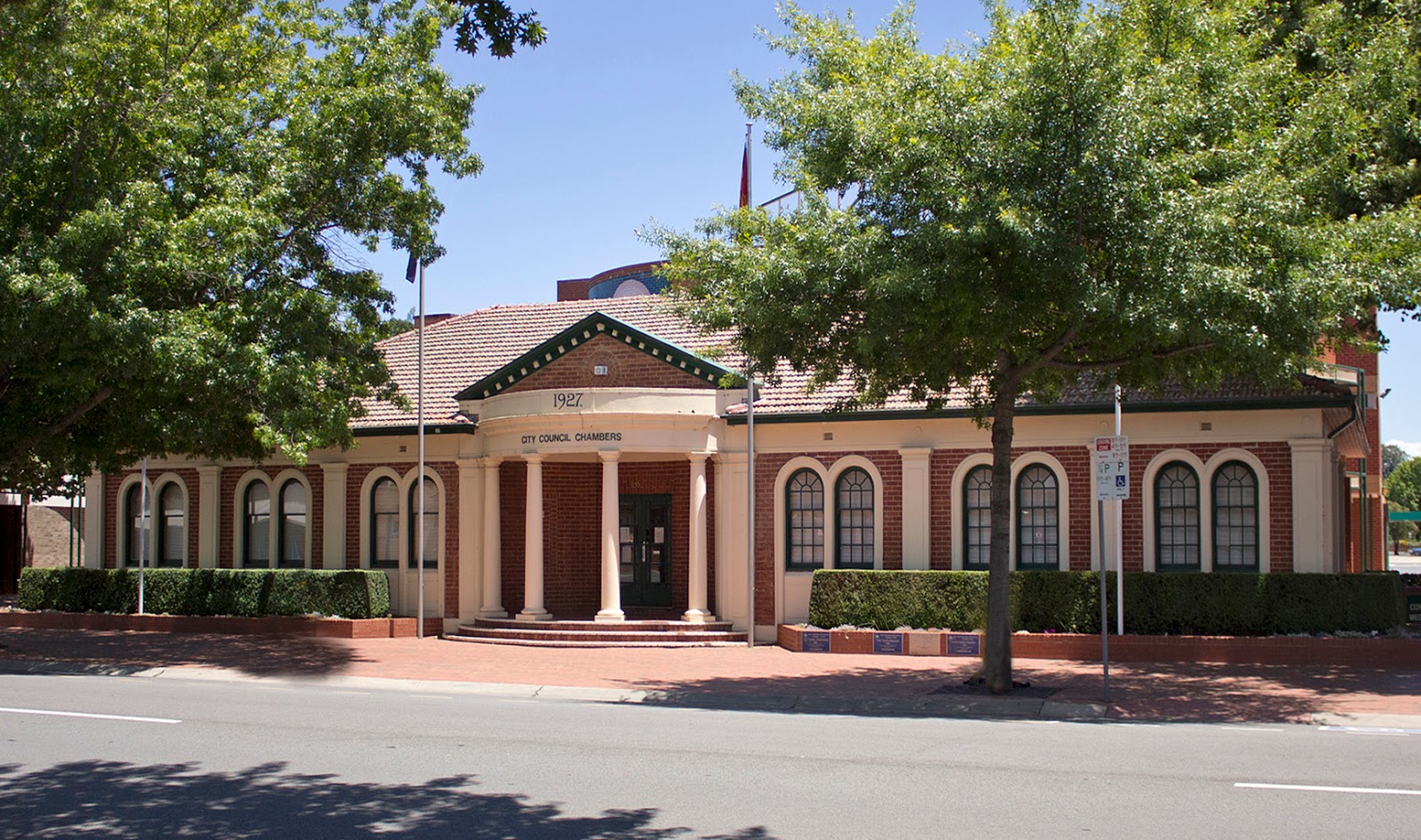
QUEANBEYAN, NEW SOUTH WALES

Queanbeyan is a regional centre on the Southern Tablelands in south-eastern New South Wales adjacent to the Australian Capital Territory. The city's mixed economy is based on light construction, manufacturing, service, retail and agriculture. It is the council seat of the Queanbeyan-Palerang Regional Council.

At the 2011 census census, Queanbeyan had a population of 37,991. Following the founding of Canberra, Australia's federal capital, just 15 kilometres to the west, Queanbeyan has become an integral part of the capital city's economy. The word Queanbeyan is the anglicised form of Quinbean – an Aboriginal word meaning "clear waters".

This post is part of the Wednesday Waters meme,
and also part of the Outdoor Wednesday meme,
and also part of the Wordless Wednesday meme,
and also part of the ABC Wednesday meme.


Tuesday, 1 November 2016

PARLIAMENT HOUSE, CANBERRA

Parliament House is the meeting place of the Parliament of Australia, located in Canberra, the capital of Australia. The building was designed by Mitchell/Giurgola & Thorp Architects and opened on 9 May 1988 by Elizabeth II, Queen of Australia. It cost more than A$1.1 billion to build.

Federal Parliament meetings were first held in Melbourne until 1927. Between 1927 and 1988, the Parliament of Australia met in the Provisional Parliament House, which is now known as "Old Parliament House". Construction of Australia's permanent Parliament House was delayed while its location was debated. Construction of the new building began in 1981.

The principal design of the structure is based on the shape of two boomerangs and is topped by an 81-metre flagpole. Parliament House contains 4,700 rooms, and many areas are open to the public. The main foyer contains a marble staircase and leads to the Great Hall, which has a large tapestry on display.

The House of Representatives chamber is decorated green, while the Senate chamber has a red colour scheme. Between the two chambers is the Members' Hall, which has a water feature and is not open to the public. The Ministerial Wing houses the office of the prime minister and other ministers.

This post is part of the Our World Tuesday meme,
and also part of the Ruby Tuesday meme,
and also part of the Travel Tuesday meme,
and also part of the Wordless Wednesday meme.


Monday, 31 October 2016

GHOULIES & GHOSTIES...

This is our local historic cemetery (you can read more about it here), which i have post-processed and edited in Photoshop, just to give it that Halloween edge...

This post is part of the Blue Monday meme,
and also part of the Through my Lens meme,
and also part of the Seasons meme,
and also part of the Our World Tuesday meme.

Sunday, 30 October 2016

HAPPY HALLOWEEN!

H A P P Y   H A L L O W E E N !

I've merged photographic images with digital art in Photoshop to create this image.

This post is part of the Saturday Silhouettes meme,
and also part of the Our Beautiful World meme,
and also part of the My Sunday Photo meme,
and also part of the Photo Sunday meme.

Saturday, 29 October 2016

PORT MELBOURNE BEACH

Port Melbourne Beach begins at the southeast end of Station Pier, running parallel to Beach St, and joins South Melbourne Beach further along, and eventually down to St Kilda Beach. The high rise apartment blocks and palm trees along Beach St give the locale a cosmopolitan feel, but looking out towards the sea, one can imagine oneself in quite a remote area. Nevertheless, it is only about 3 km south of the CBD.

This post is part of the Skywatch Friday meme,
and also part of the Saturday Silhouettes meme,
and also part of the Scenic Weekends meme.


Friday, 28 October 2016

FRIDAY GREENS #95 - TRANQUIL PARKLANDS

Welcome to this meme active every Friday. The theme is "Friday Greens" and you can post images, art, photos where the predominant colour is GREEN!
GREEN is the colour between blue and yellow in the spectrum; coloured like grass or emeralds.
This post is also part of the Skywatch Friday meme.
If you take part in this meme:
Please link back to this page from your blog, with the Friday Greens logo or link text;
In the spirit of community, please visit other participants to see their photos and leave a comment;
Say hello here in the comments box, which is always appreciated!

Thursday, 27 October 2016

COMMON VETCH

Common vetch (Vicia sativa subsp. sativa) is a nitrogen fixing leguminous plant in the family Fabaceae. Although considered a weed when found growing in a cultivated grainfield, this hardy plant is often grown deliberately as green manure or livestock fodder.

Vicia sativa is a sprawling annual herb, with hollow, four-sided, hairless to sparsely hairy stems which can reach two meters in maximum length. The leaves are stipulate, alternate and compound, each made up of 3 to 8 opposite pairs of linear, lance-shaped, oblong, or wedge-shaped, needle-tipped leaflets up to 3.5 cm long. Each compound leaf ends in a branched tendril. The pea-like flowers occur in the leaf axils, solitary or in pairs. The flower corolla is 1 to 3 cm in length and bright pink-purple in colour, more rarely whitish or yellow. The flowers are mostly visited by bumblebees. The fruit is a legume pod up to 6 or 7 cm long, which is hairy when new, smooth later, then brown or black when ripe. It contains 4-12 seeds.

It is widely naturalised in Australia, but most common and widespread in the southern parts of the country (i.e. in many parts of New South Wales, in the ACT, Victoria and Tasmania, in the south-eastern and southern parts of South Australia, and in south-western Western Australia). Occasionally also naturalised in the cooler parts of south-eastern Queensland. Also widely naturalised in North America (i.e. Canada and the USA).

Common Vetch has been part of the human diet, as attested by carbonised remains found at early Neolithic sites in Syria, Turkey, Bulgaria, Hungary and Slovakia. It has also been reported from predynastic sites of ancient Egypt, and several Bronze Age sites in Turkmenia and Slovakia. However, definite evidence for later vetch cultivation is available only for Roman times.

This post is part of the Floral Friday Fotos meme,
and also part of the Friday Greens meme.


Wednesday, 26 October 2016

PATRAS, GREECE

Patras (Modern Greek: Πάτρα, Classical Greek: Πάτραι (pl.), Latin: Patrae (pl.)) is Greece's third largest city and the regional capital of Western Greece, in the northern Peloponnese, 215 km west of Athens. The city is built at the foothills of Mount Panachaikon, overlooking the Gulf of Patras. Patras has a population of 213,984 (in 2011). According to the results of 2011 census, the population of the metropolitan area has a population of 260,308 and extends over an area of 738.87 km2.

The core settlement has a history spanning four millennia; in the Roman period it had become a cosmopolitan centre of the eastern Mediterranean whilst, according to Christian tradition, it was also the place of Saint Andrew's martyrdom. St Andrew's Cathedral (Agios Andreas, Άγιος Ανδρέας in Greek) is a Greek Orthodox basilica in the east side of the city. Along with the nearby old church of St. Andrew, it constitutes a place of pilgrimage for Christians from all over the world. Construction of the Greek Byzantine-style church began in 1908 under the supervision of the architect Anastasios Metaxas, followed by Georgios Nomikos. It was inaugurated 66 years later, in 1974. It covers approximately 1,800 square meters. It is the largest church in Greece and the third-largest Byzantine-style church in the Balkans, after the Cathedral of Saint Sava in Belgrade and Alexander Nevsky Cathedral in Sofia. Over the central dome there is a 5-meter-long, gold-plated cross and over the other domes there are 12 smaller crosses. These crosses symbolise Jesus and His apostles. The interior of the church is decorated with Byzantine-style wall paintings and mosaics (see photos here).

Dubbed as Greece's Gate to the West, Patras is a commercial hub, while its busy port is a nodal point for trade and communication with Italy and the rest of Western Europe. The city has two public universities and one Technological Institute, hosting a large student population and rendering Patras a major scientific centre with a field of excellence in technological education.

The Rio-Antirio bridge connects Patras' easternmost suburb of Rio to the town of Antirrio, connecting the Peloponnese peninsula with mainland Greece. Every year, in February, the city hosts one of Europe's largest and most colourful carnivals: notable features of the Patras Carnival include its mammoth satirical floats and extravagant balls and parades, enjoyed by hundreds of thousands of visitors in a pleasant Mediterranean climate. Patras is also famous for supporting an indigenous cultural scene active mainly in the performing arts and modern urban literature. It was European Capital of Culture in 2006.

This post is part of the Wednesday Waters meme,
and also part of the Outdoor Wednesday meme,
and also part of the Wordless Wednesday meme,
and also part of the ABC Wednesday meme
and also part of the Travel Tuesday meme.

Tuesday, 25 October 2016

CAGLIARI, SARDINIA

Cagliari (Sardinian: Casteddu; Latin: Caralis) is an Italian municipality and the capital of the island of Sardinia, an autonomous region of Italy. Cagliari's Sardinian name Casteddu literally means castle. It has about 150,000 inhabitants, while its metropolitan city (including Cagliari and 16 other nearby municipalities) has more than 431,000 inhabitants. According to Eurostat, the population of the Functional urban area, the commuting zone of Cagliari, rises to 476,974.

Cagliari is the 26th largest city in Italy and the largest city on the island of Sardinia. An ancient city with a long history, Cagliari has seen the rule of several civilisations. Under the buildings of the modern city there is a continuous stratification attesting to human settlement over the course of some five thousand years, from the Neolithic to today. Historical sites include the prehistoric Domus de Janas, very damaged by cave activity, a large Carthaginian era necropolis, a Roman era amphitheatre, a Byzantine basilica, three Pisan-era towers and a strong system of fortification that made the town the core of Spanish Habsburg imperial power in the western Mediterranean Sea.

Its natural resources have always been its sheltered harbour, the often powerfully fortified hill of Castel di Castro, the modern Casteddu, the salt from its lagoons, and, from the hinterland, wheat from the Campidano plain and silver and other ores from the Iglesiente mines. Cagliari was the capital of the Kingdom of Sardinia from 1324 to 1848, when Turin became the formal capital of the kingdom (which in 1861 became the Kingdom of Italy). 

Today the city is a regional cultural, educational, political and artistic centre, known for its diverse Art Nouveau architecture and several monuments. It is also Sardinia's economic and industrial hub, having one of the biggest ports in the Mediterranean Sea, an international airport, and the 106th highest income level in Italy (among 8,092 comuni), comparable to that of several northern Italian cities. It is also the seat of the University of Cagliari, founded in 1607, and of the Primate Roman Catholic archdiocese of Sardinia, since the 5th century AD.

This post is part of the Our World Tuesday meme,
and also part of the Ruby Tuesday meme,
and also part of the Travel Tuesday meme,
and also part of the Wordless Wednesday meme.