This is a blog where I post my favourite photographs from around the places I've visited. I am an amateur photographer and I am ever learning as I go along!
Thursday, 23 March 2023
ASTILBE
Thursday, 9 March 2023
KOTOBUKI BEGONIA
Thursday, 16 February 2023
Thursday, 12 January 2023
PINK HIBISCUS
Thursday, 13 October 2022
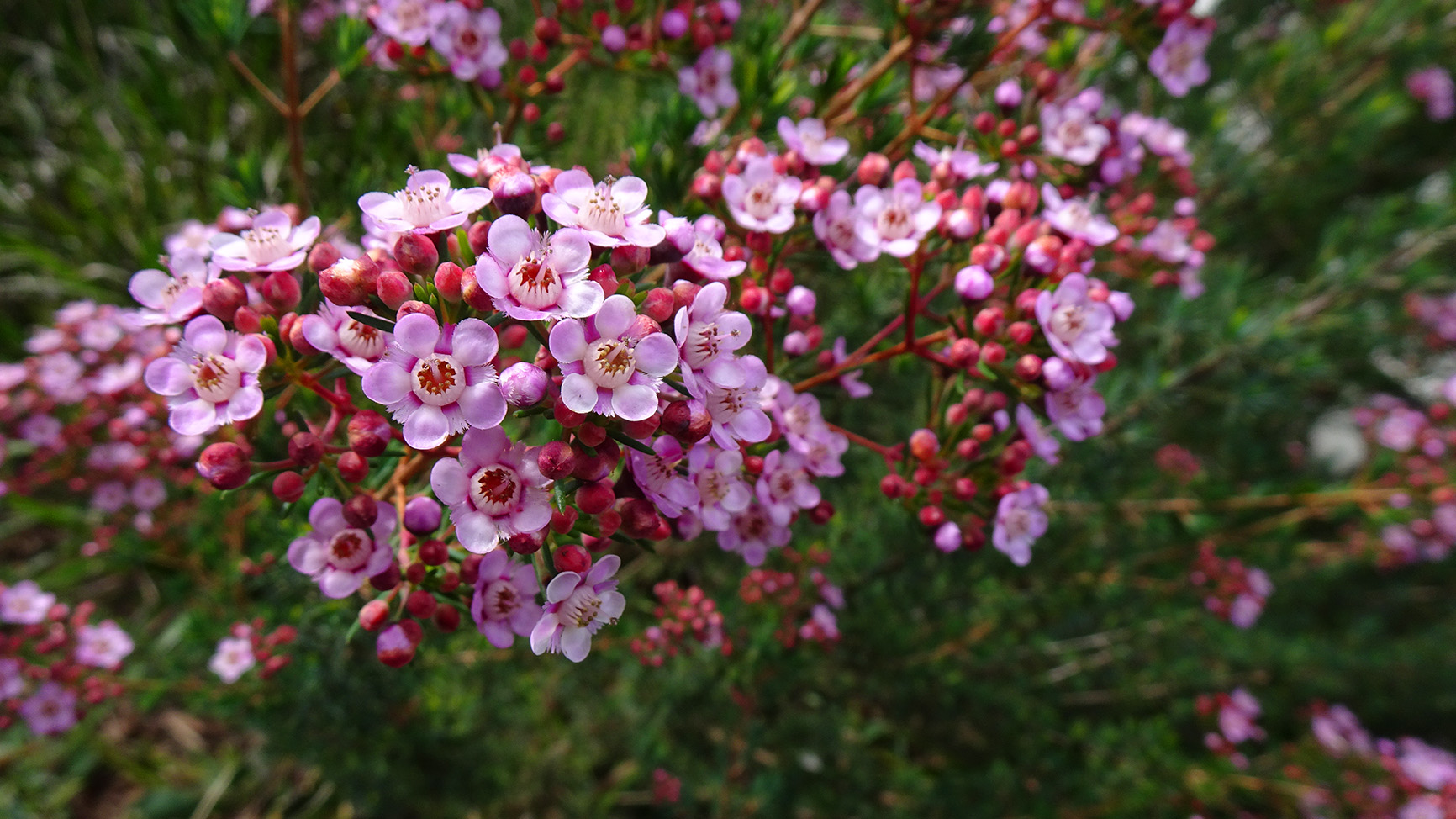
CROWEA
Thursday, 6 October 2022
Thursday, 29 September 2022
Thursday, 17 March 2022
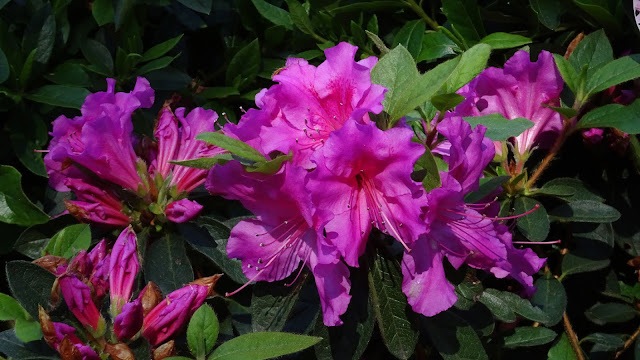
EVERGREEN AZALEA
Thursday, 13 January 2022
HIBISCUS
Thursday, 30 December 2021
Thursday, 15 July 2021
ANDROMEDA
Andromeda polifolia, common name bog-rosemary, is a species of flowering plant native to Northern parts of the Northern Hemisphere. It is the only member of the genus Andromeda, and is only found in bogs in cold peat-accumulating areas.
It is a small shrub growing to 10–20 centimetres (rarely to 40 cm) tall with slender stems. The leaves are evergreen, alternately arranged, lanceolate, 1–5 centimetres long and 2–8 millimetres broad, dark green above (purplish in winter) and white beneath with the leaf margins curled under.
The flowers are bell-shaped, white to pink, 5–8 mm long; flowering is in late spring to early summer. The fruit is a small capsule containing numerous seeds. 'Compacta' shown here is a small evergreen shrub to 20cm in height, with oval leaves and terminal clusters of clear pink, globose flowers.
This post is part of the Floral Friday Fotos meme.
Thursday, 17 June 2021
PANSY ORCHID
Miltonia, abbreviated Milt. in the horticultural trade, is an orchid genus formed by nine epiphyte species and eight natural hybrids inhabitants of the Brazilian Atlantic Forest, one species reaching the northeast of Argentina and east of Paraguay. This genus was established by John Lindley in 1837, when he described its type species, Miltonia spectabilis. Many species were attributed to Miltonia in the past, however, today, the species from Central America and from cooler areas on northwest of South America have been moved to other genera.
Miltonia species have large and long lasting flowers, often in multifloral inflorescences. This fact, allied to being species that are easy to grow and to identify, make them a favourite of orchid collectors all over the world. Species of this genus are extensively used to produce artificial hybrids. Despite the fact that Miltonia is now a well established genus, most of its species were originally classified under other genera as Cyrtochilum, Oncidium, Odontoglossum, and Brassia. All were discovered between 1834 and 1850 with the exception of M. kayasimae, discovered only in 1976.
These epiphytic orchids occur from Central to Southern Brazil down to Argentina. They are named after Charles Wentworth-Fitzwilliam, 5th Earl Fitzwilliam, formerly Viscount Milton, an English orchid enthusiast. These orchids have two leaves, arising from a pseudobulbs, covered with a foliaceous sheath. The inflorescence consists of waxy, nonspurred flowers. The lip is large and flat and lacks a callus at its base. They possess a footless column with two hard pollinia. The flowers have a delicate, exotic scent, some compare to that of roses. The species in this genus are sometimes referred to as the "pansy orchids", but it is the Miltoniopsis orchids that have flowers that closely resemble the pansy. Almost everyone except for the most serious orchid hobbyists use the name pansy orchids interchangeably, which may cause confusion.
This post is part of the Floral Friday Fotos meme.
Monday, 23 November 2020
Thursday, 29 October 2020
Thursday, 30 July 2020
RHODODENDRON
This variety is "sierra Sunset" and the flowers combine red, yellow, orange and cream colours in a spectacular blend. This hybrid was cultivated by the late Jack Lofthouse. The foliage is dark-green and lustrous on a dense full shrub. Height 1.3m, and flowers October (Southern Hemisphere).
This post is part of the Floral Friday Fotos meme.