Thursday, 23 June 2011

HOSIER LANE - VANDALISM OR ART?

Hosier Lane in Melbourne, is found between Swanston and Russell Sts, extending from Flinders Street through to Flinders Lane. In the 1920s businesses in Hosier Lane were diverse and included an organ manufacturer, a warehouse for a men's clothing company, and a costume manufacturer. The nearby Higson and Oliver Lanes had warehouses that were predominantly used by businesses involved in the manufacturing of clothes and the name of this lane reflects its association with clothing.


Hosier Lane today is well known for its bars but mostly for the graffiti and stencil art that can be seen on its 19th century brick walls. The artwork decorating the walls near number 1 Hosier Lane and near Misty Place at number 3-5 Hosier Lane have been approved by the City of Melbourne as registered street artwork.


Melbourne City Council regards graffiti as primarily a product of an urban environment that should be engaged with creatively, not something that it merely takes a strict zero tolerance approach to. This engagement is seen as a diversion that hopes to tame a vigorous and diverse form of expression. By having certain areas of the city where street artists can express themselves, graffiti on unacceptable locations can be controlled.


Graffiti artists at work in Rutledge Lane, a C-shaped offshoot to the west of Hosier lane.


Yes, but is art? Ellen Dissanayake says that art is (amongst other things):

·  the product of conscious intention,
·  a self rewarding activity,
·  a tendency to unite dissimilar things,
·  a concern with change and variety,
·  the aesthetic exploitation of familiarity vs. surprise,
·  the aesthetic exploitation of tension vs. release,
·  the imposition of order on disorder,
·  the creation of illusions,
·  an indulgence in sensuousness,
·  the exhibition of skill,
·  a desire to convey meanings,
·  an indulgence in fantasy,
·  the aggrandizement of self or others,
·  illustration,
·  the heightening of existence,
·  revelation,
·  personal adornment or embellishment,
·  therapy,
·  the giving of meaning to life,
·  the generation of unselfconscious experience,
·  the provision of paradigms of order and/or disorder,
·  training in the perception of reality


If art is to adorn, to beautify, to express, to illustrate, to mediate, to persuade, to record, to redefine reality, and to redefine art, Hosier Lane is truly art...


A vandal (apart from the historical reference to the Germanic people of the fourth and fifth centuries who invaded and sacked parts of Western Europe), is understood to be a wilful or ignorant destroyer of property, or of anything beautiful, venerable, or worthy of preservation...


Art is often in the eye of the beholder. Someone who likes admiring the neat symmetry and wonderful workmanship of 19th century brickwork, mellowed by the elements and time would regard the graffiti in Hosier Lane as vandalism. Someone who is stimulated by the wild expanses of colour and form, quirky subject matter and loves the challenging "in-your-face" immediacy of the graffiti would quickly say this is truly art, as defined above.


What do you think? What is this above, art or vandalism?


 Graffiti happening in real time!


The subject matter is quite diverse, but dominating the "canvases" are the highly ornate text of obscure messages, counter-culture catch phrases and "me pinxit" names...


The graffiti causes great delight in some!


Stencils also adorn the walls. Dlux, a Melbourne stencil artist, claims there is an ethic within stencillers’ circles about which sites constitute fair game – "artists," he says, "avoid heritage buildings and, for the most part, residential properties." He also says that "...racist and sexist stencils generally will not last long on the wall. People [other artists] react much more negatively to sexist or racist graffiti. They get covered over much more quickly. People will add their own messages to offensive stencils …" (The Age, 16 August 2003).


Considerable ingenuity can be seen when a wall is covered by stencils or graffiti (or often a combination of both).


Graffiti art being created.


"The City of Melbourne will work with property owners, mangers and occupiers, graffiti writers, Victorian Police and local communities to investigate providing legitimate avenues for murals and street art to be displayed. The City of Melbourne will engage with the arts community regarding murals and street art, for example, in conjunction with cultural festivals or arts development projects in the public domain. The City of Melbourne will positively engage with graffiti writers in mentoring and arts programmes to facilitate opportunities for legitimate artistic expression and to divert their efforts away from illegal and towards high quality work."
Melbourne City Council Graffiti Management Plan, 2006


Graffiti being created in Rutledge Lane.


We are multicultural, even in our graffiti!


For me personally, this image exemplifies the difference between art and vandalism. This graffiti (self?) portrait, is art; but the graffiti scrawl that defaces it, is vandalism...

Thursday, 26 May 2011

THE AUTUMN GARDEN

Autumn

Season of mists and mellow fruitfulness,
Close bosom-friend of the maturing sun;
Conspiring with him how to load and bless
With fruit the vines that round the thatch-eves run;
To bend with apples the moss’d cottage-trees,
And fill all fruit with ripeness to the core;
To swell the gourd, and plump the hazel shells
With a sweet kernel; to set budding more,
And still more, later flowers for the bees,
Until they think warm days will never cease,
For Summer has o’er-brimm’d their clammy cells.

John Keats, 1820
The poinsettia (Euphorbia pulcherrima) is beginning to put on a splendid display.
The persimmons (Diospyros spp) decorate the bare twigs of their tree.
Myrtle (Myrtus communis) berries make a beautiful show
The bergenias (Bergenia cardifolia) make a splendid show.
The African yellow daisy (Euryops spp) brightens up even the dullest day.
Nasturtium leaves love catching the raindrops.
Ripening grapefruit (Citrus x paradisi) promise sweet delights in mid-winter.
One of the least demanding and most rewarding of fruit trees: The tamarillo (Solanum betaceum). 
A discarded fig leaf leaving branches shamelessly bare...
One of the last yellow tea roses, braving the cold and wet weather.
This one is rather sad...
Japanese maple (Acer palmatum) leaves choosing a watery grave.
Beautiful, bright blooms of the Camellia sasanqua are at their best now.
The humble Viola tricolor rarely stops blooming.
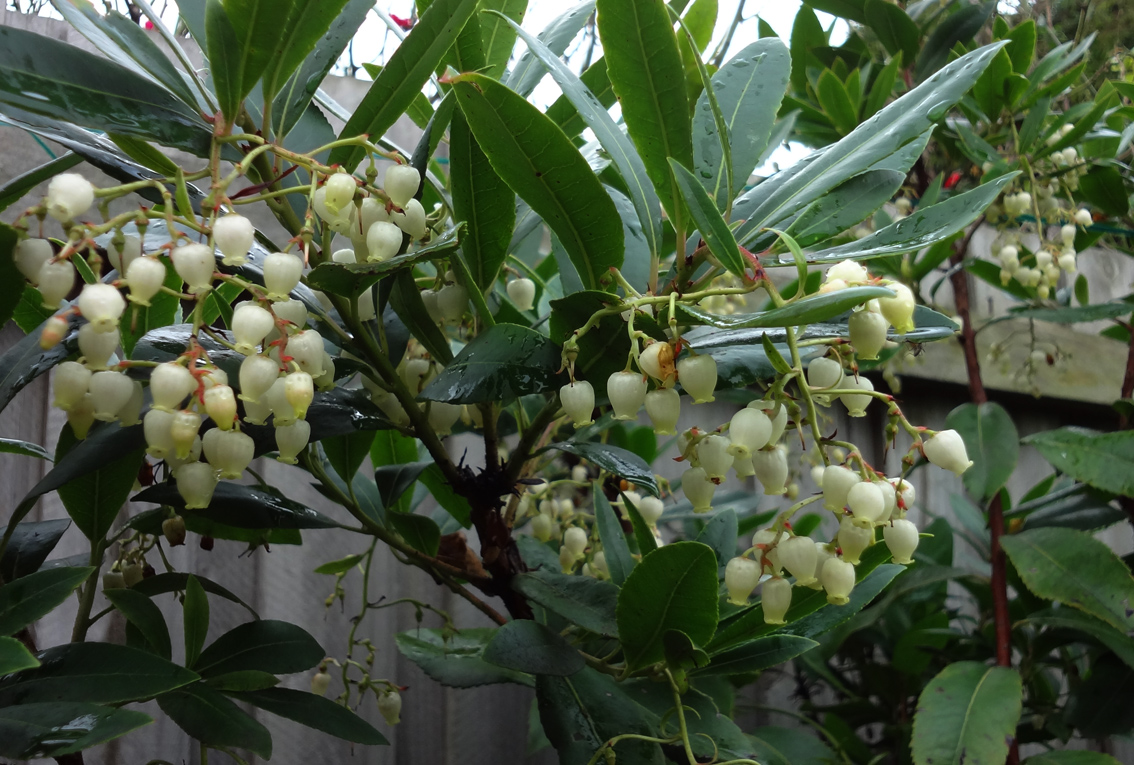
Irish strawberry tree (Arbutus unedo) flowers, soon to be succulent prickly berries.
Succulents always look good whatever the season!
The chrysanthemums are just about finishing their display now.
It's a beautiful season...

Monday, 16 May 2011

HANOI 2 - VIETNAM

Here are some more photographs from Hanoi to finish off the last two posts.
The original Tran Quoc pagoda was built in the 6th century and is considered the oldest in Vietnam. It was founded on the bank of the Red River by King Ly Nam De who named it Khai Quoc (National Founder). Much later, it was moved to its present site beside Hanoi’s Ho Tay (West) Lake during the reign of King Le Kinh Tong (1600-1618) and renamed Tran Quoc (National Defence). The current building is the result of major renovations in 1815.
Waiting to enter the temple precinct of the Tran Quoc pagoda.
The term "pagoda" is from Portuguese "pagode", perhaps based on Persian "butkada" - ‘temple of idols,’ influenced by Prakrit "bhagodī" - ‘divine’.
The altar in the temple adjacent to the Tran Quoc pagoda.
The loads carried on bicycles around the city are simply astounding!
Thousands upon thousands of lotus blossoms (Nelumbo nucifera) are offered daily in temples. Here the buds are being prepared for sale.
We went to see the Ho Chi Minh Mausoleum, which is open from 8:00-11:00 am Tuesdays-Thursdays and at weekends. Be prepared for extremely long queues and a long wait!
The large mausoleum where Ho Chi Minh's embalmed body lies in a bier inside a glass case. Visitors must file through the room without stopping. No photography is allowed, and all personal possessions must be left outside.
The building was erected with assistance from the USSR, and is a good example of Soviet architecture of the period. It’s guarded by an honour guard of Vietnamese soldiers in immaculate white dress uniforms who march around the building at regular intervals. Ho Chi Minh left directions for his cremation in his will. However, at the time of his death in 1969, the year after the Tet Offensive, the war was still raging and morale was low. Communist Party chiefs recognised his iconic status and overrode his wishes.
The One Pillar Pagoda was built originally in 1049 during the Ly dynasty and is located on the west side of the original capital of Thang Long. According to the legend, King Ly Thai To dreamt that Goddess Quan Am sat on a lotus leaf and promised him a son. Soon after the king married a peasant girl and she bore him a son. The king became so overwhelmingly happy that he constructed a wooden pagoda on a stilt in a lake so that the goddess of Mercy- Quan Am, could be venerated and the long life of his son could be assured. He named the pagoda “Dien Huu”, which means happiness and good luck. According to a theory, the pagoda was built in a style so as to resemble a lotus emerging out of the water.
The pagoda is both small and striking. It is an extremely popular attraction and place of pilgrimage.
 The altar inside the One Pillar Pagoda.
 Young devotees lighting incense and praying outside the One Pillar Pagoda.
The Ho Chi Minh Museum preserves everything memorable related to the great revolutionist, Ho Chi Minh. The Museum consists of five extensive floors and was inaugurated on 2nd September, 1990, celebrating the 100th birthday occasion of the beloved Vietnamese President.

The area around the Ho Chi Minh Museum and Mausoleum is full of extensive gardens, parks, temples and other attractions, so definitely an area of the city worth visiting.
The Hanoi Citadel complex is in the process of being released by the Army - two buildings are now accessible, and more are to follow. Originally known as the Dai La Citadel, King Ly Thai To renamed it Thang Long Citadel (“Ascending Dragon” – the old name of Hanoi) in 1010. Over many centuries various monarchs moved the capital to other places and their successors moved it back again to Hanoi often modifying and rebuilding elements of the Citadel several times. In 1888 the defeated Nguyen Dynasty surrendered the Hanoi Citadel to the French colonialists. Hanoi became a colonial city for 66 years until the French were expelled in 1954. During their occupancy, the colonists broke down the walls of Citadel and destroyed most of the buildings inside. The old Watchtower remains, and offers an excellent view of the whole complex.
The Army Museum is located next to the Citadel and offers a vivid and fascinating history of the Vietnam War under the leadership of Vietnam’s communist party and of president Ho Chi Minh. The history of Vietnam’s struggle for peace, independence and freedom of the nation is captured in the thousands of exhibits of the museum.
The museum displays a wide collection of military waste including a MIG fighter, anti-aircraft missiles, tanks, and remarkable heap of wreckage from a US B52 bomber and French prop driven plane that were both blast in the Hanoi area and the tank that exploded through the gates in Saigon during the battle for liberation.
One of the back streets of Hanoi.
A barber plying his trade on the sidewalk in an improvised salon!
Maison Centrale, or to be precise, Hoa Lo Prison (Hoa Lo in Vietnamese means "fiery furnace"), is the infamous "Hanoi Hilton", as what the American prisoners-of-war nicknamed it, a sarcastic reference to the upmarket Hilton hotel chain. Its most famous inmate was probably Douglas Pete Peterson, the first US ambassador to the Socialist Republic of Vietnam, and John McCain, the US pilot who later became a senator. The name Maison Centrale comes from the French, where the term Maison Centrale usually refers to a prison back in France.
Maison Centrale housed Vietnamese political prisoners during their struggle for independence during the colonial period. In 1997 most of the complex was demolished to give away for development, but only parts of the old prison was preserved and turned to museum. It is an amazing experience seeing how the inmates used to live, how they were tortured and executed.
The original guillotine used in the executions of condemned prisoners.
A memorial to all the victims of torture and execution in the prison.
One of a series of plaques depicting the wretched life of hardship and torture inside the prison.
The National Cancer Institute is the leading hospital specialising in cancer treatment of Vietnam, which was established on the existing Indochina Radium Institute, the most long-standing unit for cancer control in the region (since 1923), established by the French in a more benevolent mood.
St. Joseph’s Cathedral is built in European neo-Gothic style and dominates a small square in the heart of Hanoi’s tourist area facing a street of restaurants and boutiques. It was one of the first buildings erected by the French colonists, and was completed in 1886 – many of the materials and most of the craftspeople were imported from France. Most of the stained glass windows are original and good examples of the craft. Unfortunately it was closed when we visited.
The Hanoi Opera House rises magnificently at the end of the Trang Tien Street. Modelled on the Parisian Palais Garnier, and built by the French colonists in 1911 it was renovated in the late 1990s. The façade of the building is colonial French with pillars and balconies overlooking the city centre. Various performances of art - local, international, traditional, modern are staged at this 900-seat opera house, professionally managed by a solid team of various experts with the Vietnamese symphonies playing quite regularly. 
A timeless picture captured from the taxi, on our way to the airport.
Rice paddy and lone cyclist...