Tuesday, 8 November 2016

LA ROQUE GAGEAC, FRANCE

La Roque Gageac is one of France's most beautiful villages. In a stunning position on the north bank of the Dordogne River, and backed by a steep hill / cliffs, with little to suggest that much has changed there in the last 300 years, La Roque-Gageac is truly the perfect picture postcard village. It is about 8km from the historic town of Sarlat.

The golden yellow houses with their traditional Perigord roofs, line the river and spread up the hill behind. While some of the properties in La Roque Gageac are quite modest, there is also an impressive number of grand houses among them. One of the grandest of these is near the road as you enter from Beynac - the 19th century (although it appears older) Chateau de la Malartrie built in Renaissance style.

The strong defensive position of La Roque Gageac and the fortress whose defences continued to be elaborated up to the 17th century meant that it held an important strategic and defensive position in the area. Just below the troglodyte fort is one of La Roque-Gageac's most impressive buildings - the Renaissance Manoir de Tarde with its round tower and mullion windows.

This post is part of the  Our World Tuesday meme,
and also part of the Ruby Tuesday meme,
and also part of the Travel Tuesday meme,
and also part of the Wordless Wednesday meme.

Monday, 7 November 2016

THE BLUE ROSE

A blue rose is a flower of the genus Rosa (family Rosaceae) that presents blue-to-violet pigmentation instead of the more common red, white, or yellow. Blue roses are often portrayed in literature and art as symbols of love, prosperity, or immortality. However, as a result of genetic limitations, it does not exist in nature.

As roses lack the specific gene that has the ability to produce a "true blue" colour, blue roses are created by dyeing white roses.In a book entitled Kitab al-felahah written by Ibn al-‘Awwām al-Ishbīlī[ in Arabic in the 12th century, and translated into French by J. J. Clement as Le lLvre de l'Agriculture, there are references to azure blue roses that were known in the orient. These blue roses were made by placing a blue dye into the bark of the roots.

Scientists are yet to produce a truly blue coloured rose, however, after thirteen years of collaborative research by an Australian company, Florigene, and a Japanese company, Suntory, a rose containing the blue pigment delphinidin was created in 2004 by genetic engineering of a white rose. The company and press have described it as a blue rose, but it is lavender or pale mauve in colour.

The genetic engineering involved three alterations – adding two genes, and interfering with another. First the researchers inserted a gene for the blue plant pigment delphinidin cloned from the pansy into a purplish-red Old Garden rose 'Cardinal de Richelieu', resulting in a dark burgundy rose. The researchers then used RNA interference (RNAi) technology to depress all other colour production by endogenous genes by blocking a crucial protein in colour production, called dihydroflavonol 4-reductase (DFR), and adding a variant of that protein that would not be blocked by the RNAi but that would allow the colour of the delphinidin to show.

If the strategy worked perfectly, in theory it could produce a truly blue rose. However the RNAi did not completely knock out the activity of DFR, so the resulting flower still made some of its natural colour, and so was a red-tinged blue – a mauve or lavender. Additionally, rose petals are more acidic than pansy petals, and the pansy delphinidin in the transgenic roses is degraded by the acidity in the rose petals. Further deepening the blue colour would therefore require further modifications, by traditional breeding or further genetic engineering, to make the rose less acidic.

As of 2008 the GM roses were being grown in test batches at the Martino Cassanova seed institution in South Hampshire, according to company spokesman Atsuhito Osaka. Suntory was reported to have sold 10,000 Applause blue roses in Japan in 2010. Prices were from 2,000 to 3,000 Yen or US$22 to 35 a stem.

This post is part of the Blue Monday meme,
and also part of the Macro Monday meme,
and also part of the Through my Lens meme,
and also part of the Seasons meme.
The legendary blue rose, what every florist desires! My photo of a white rose which I have edited with Photoshop.


Dyed blue roses

The Suntory Blue Rose, 'Applause' (TM)


There are some traditionally bred roses that have a lilac/lavender colour and are available for planting in your garden. We have "Blue Moon", but there are also "Blue for You", "Purple Haze", "Nautica", "Amnesia" and illustrated below is "Ocean Song":
"Ocean Song" roses

Friday, 4 November 2016

FRIDAY GREENS #96 - SPRING

Welcome to this meme active every Friday. The theme is "Friday Greens" and you can post images, art, photos where the predominant colour is GREEN!
GREEN is the colour between blue and yellow in the spectrum; coloured like grass or emeralds.
The Australian Painted Lady butterfly shown here, Vanessa kershawi, can easily be mistaken for its cosmopolitan relative Vanessa cardui. In V. kershawi however 3 of the ocelli on the hindwings have prominent blue centres, and the hindwings also have a blackish apex that in confluent with the 4th (upper) ocellus. Vanessa kershawi is found throughout most of Australia. It occurs as a regular breeding migrant in lowland areas of New Zealand but does not survive winters there.

Erysimum cheiri syn. Cheiranthus cheiri (common name "wallflower") is a species of flowering plant in the family Brassicaceae (Cruciferae), native to Europe but widespread as an introduced species elsewhere. It is also widely cultivated as a garden plant. It is known as giroflée and ravenelle in French, Goldlack in German, alhelí in Spanish and violacciocca in Italian.

This post is also part of the Floral Friday Fotos meme.
If you take part in this meme:
*Please link back to this page from your blog, with the Friday Greens logo or link text;
*In the spirit of community, please visit other participants to see their photos and leave a comment;
*Say hello here in the comments box, which is always appreciated!

Thursday, 3 November 2016

ABUTILON

Abutilon or Chinese lantern is closely related to Hibiscus, and most of the hundred or so species have pendulous, hibiscus-like flowers. Cultivars produced by hybridising some of the South American abutilons have all been placed in one group known as Abutilon x hybridum, and these are the ones most commonly grown in Australian gardens. They have a wispy, delicate form and colourful, lantern-shaped flowers. For gardeners who prefer plants with a more dense habit, new compact varieties are also available.

They are evergreen shrubs with attractive maple-like leaves and an open, pendulous habit. They grow to about 2-3 metres tall (or 50-100 cm if a compact variety). Flowers are produced in September to December, but they spot flower at other times. Flower colours include white, pink, red, yellow, orange and salmon. Abutilons grow well in most parts of Australia, except for the very cold mountain zones. In inland areas be sure to water well and keep protected with mulch. In hot inland climates abutilons appreciate some light shade.

A full sun position is best, but abutilons will also flower in part shade. They like a rich, well drained soil and a cool root run. Water well and mulch. Avoid heavy feeding as abutilons are inclined to produce foliage at the expense of flowers. Light prune to shape toward the end of winter in frost free gardens. Leave until early spring in frost-prone areas. They can become untidy and leggy like hibiscus. As abutilons are members of the Malvaceae family, they are also subject to attack by hibiscus beetle and metallic flea beetle. These pests make holes in leaves and flowers and are difficult to control with pesticides.

This post is part of the Floral Friday Fotos meme.


Wednesday, 2 November 2016

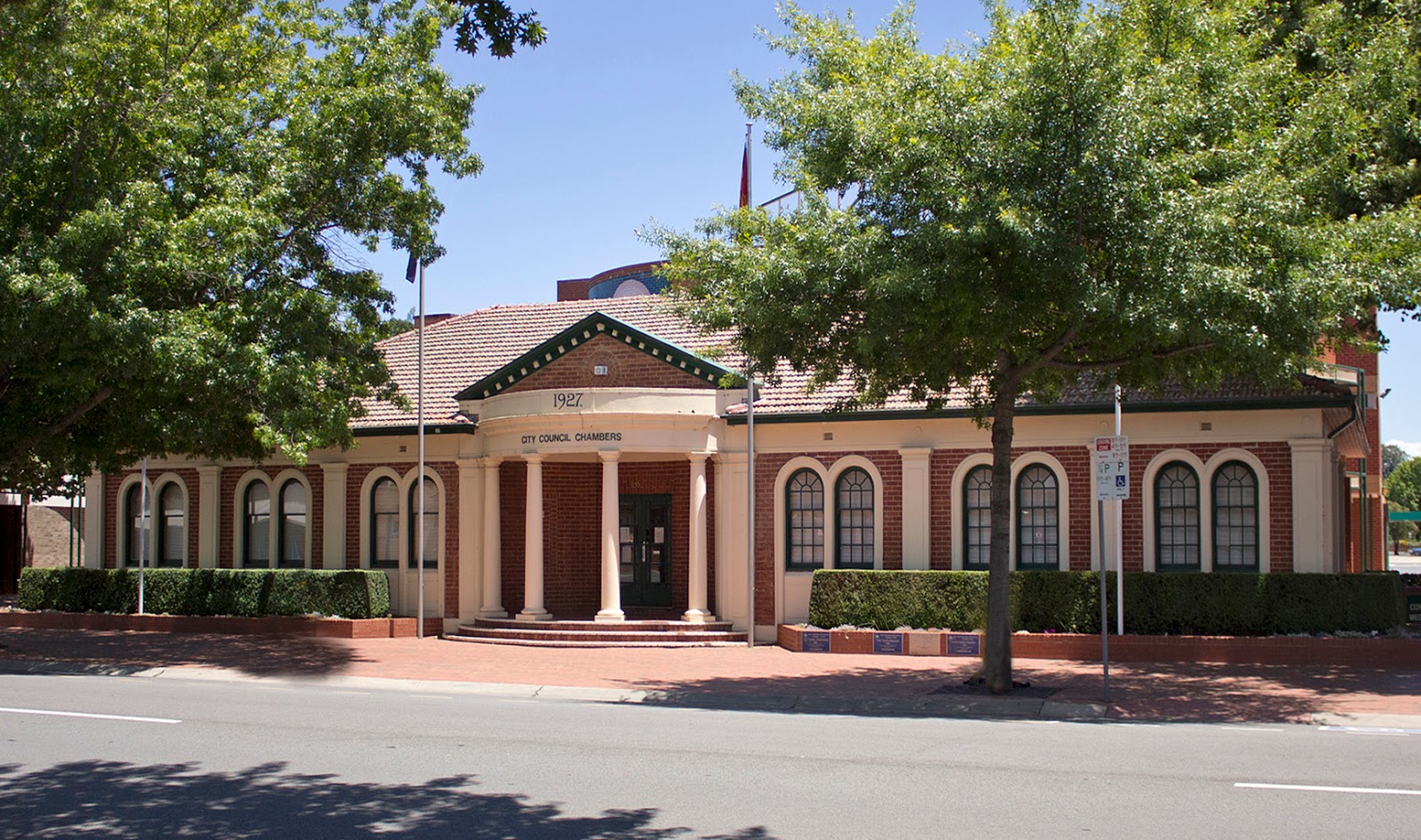
QUEANBEYAN, NEW SOUTH WALES

Queanbeyan is a regional centre on the Southern Tablelands in south-eastern New South Wales adjacent to the Australian Capital Territory. The city's mixed economy is based on light construction, manufacturing, service, retail and agriculture. It is the council seat of the Queanbeyan-Palerang Regional Council.

At the 2011 census census, Queanbeyan had a population of 37,991. Following the founding of Canberra, Australia's federal capital, just 15 kilometres to the west, Queanbeyan has become an integral part of the capital city's economy. The word Queanbeyan is the anglicised form of Quinbean – an Aboriginal word meaning "clear waters".

This post is part of the Wednesday Waters meme,
and also part of the Outdoor Wednesday meme,
and also part of the Wordless Wednesday meme,
and also part of the ABC Wednesday meme.


Tuesday, 1 November 2016

PARLIAMENT HOUSE, CANBERRA

Parliament House is the meeting place of the Parliament of Australia, located in Canberra, the capital of Australia. The building was designed by Mitchell/Giurgola & Thorp Architects and opened on 9 May 1988 by Elizabeth II, Queen of Australia. It cost more than A$1.1 billion to build.

Federal Parliament meetings were first held in Melbourne until 1927. Between 1927 and 1988, the Parliament of Australia met in the Provisional Parliament House, which is now known as "Old Parliament House". Construction of Australia's permanent Parliament House was delayed while its location was debated. Construction of the new building began in 1981.

The principal design of the structure is based on the shape of two boomerangs and is topped by an 81-metre flagpole. Parliament House contains 4,700 rooms, and many areas are open to the public. The main foyer contains a marble staircase and leads to the Great Hall, which has a large tapestry on display.

The House of Representatives chamber is decorated green, while the Senate chamber has a red colour scheme. Between the two chambers is the Members' Hall, which has a water feature and is not open to the public. The Ministerial Wing houses the office of the prime minister and other ministers.

This post is part of the Our World Tuesday meme,
and also part of the Ruby Tuesday meme,
and also part of the Travel Tuesday meme,
and also part of the Wordless Wednesday meme.


Monday, 31 October 2016

GHOULIES & GHOSTIES...

This is our local historic cemetery (you can read more about it here), which i have post-processed and edited in Photoshop, just to give it that Halloween edge...

This post is part of the Blue Monday meme,
and also part of the Through my Lens meme,
and also part of the Seasons meme,
and also part of the Our World Tuesday meme.

Sunday, 30 October 2016

HAPPY HALLOWEEN!

H A P P Y   H A L L O W E E N !

I've merged photographic images with digital art in Photoshop to create this image.

This post is part of the Saturday Silhouettes meme,
and also part of the Our Beautiful World meme,
and also part of the My Sunday Photo meme,
and also part of the Photo Sunday meme.

Saturday, 29 October 2016

PORT MELBOURNE BEACH

Port Melbourne Beach begins at the southeast end of Station Pier, running parallel to Beach St, and joins South Melbourne Beach further along, and eventually down to St Kilda Beach. The high rise apartment blocks and palm trees along Beach St give the locale a cosmopolitan feel, but looking out towards the sea, one can imagine oneself in quite a remote area. Nevertheless, it is only about 3 km south of the CBD.

This post is part of the Skywatch Friday meme,
and also part of the Saturday Silhouettes meme,
and also part of the Scenic Weekends meme.