Showing posts with label Calycanthaceae. Show all posts

Thursday, 2 July 2020

WINTERSWEET

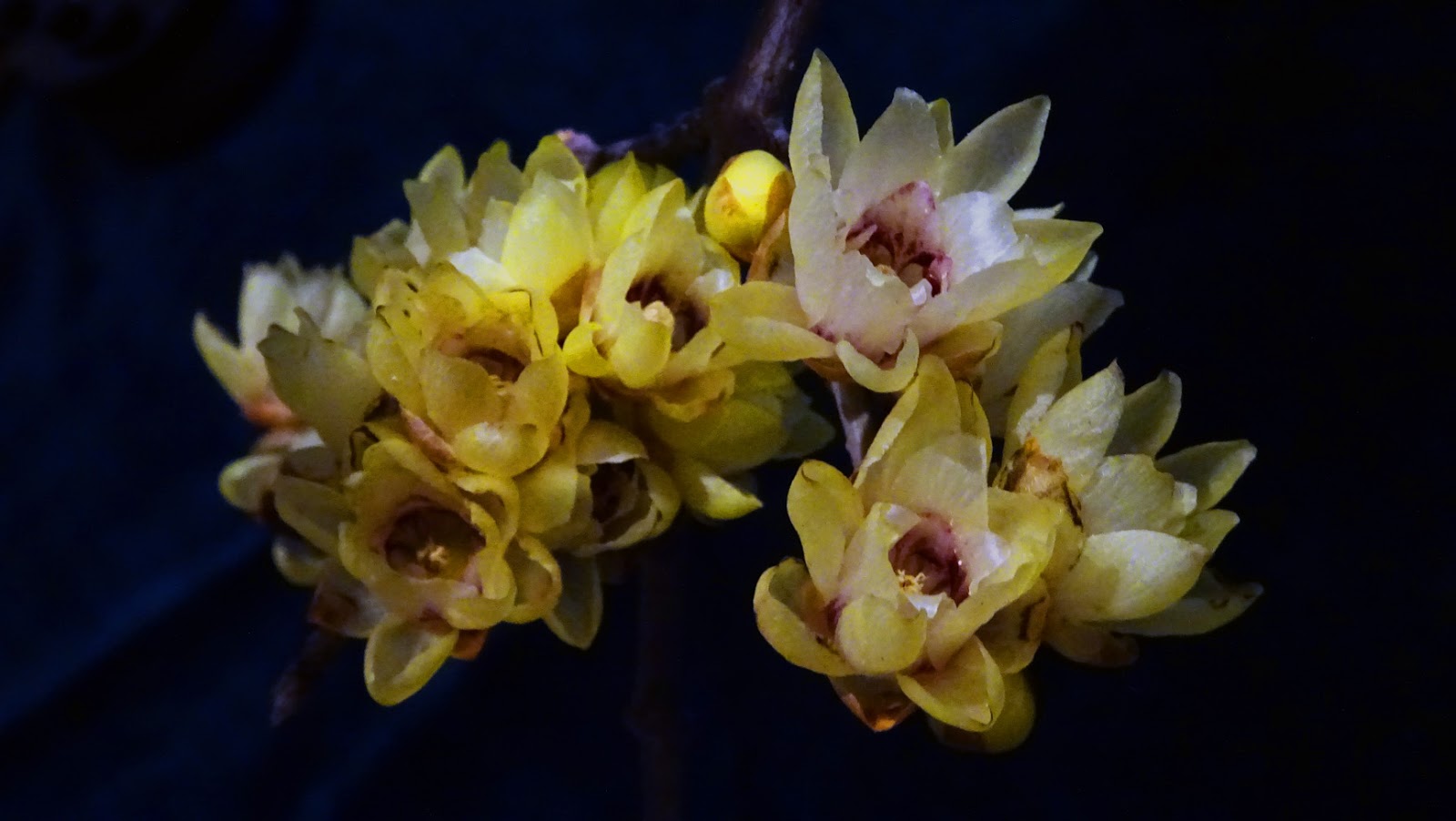
Chimonanthus praecox (wintersweet) has been cultivated in China for more than 1,000 years and has been introduced to Japan, Korea, Europe, Australia and the United States. It is a familiar plant in British gardens, where it is grown mainly for its gorgeous scent. The rather insignificant, creamy-yellow, waxy flowers are borne on bare stems from about December to March, with the leaves appearing later. Long esteemed in China and Japan for its fragrance, many parts of the plant are rich in essential oils and are also used for culinary and medicinal purposes.

Wintersweet was introduced to Japan from China during the 17th century, and to Britain, under the name of Calycanthus praecox, a century later. The generic name means "winter-flower', while the specific name means "precocious' as it flowers so early. It is a deciduous shrub (or sometimes with persistent leaves), up to 3 m high and wide (up to 13 m tall in the wild), with rough, opposite, dark green leaves and small, solitary, highly scented, yellowish flowers borne on short stalks in winter and spring before the leaves appear. The outer petals (tepals) are waxy, almost transparent, in appearance, while the inner tepals are smaller and usually purplish. The flowers are beetle-pollinated.

Named cultivars include Chimonanthus praecox ‘Luteus’, which has slightly larger flowers and yellow inner tepals, and C. praecox ‘Grandiflorus’, a larger shrub, with bigger leaves and larger, but less strongly scented, pure yellow flowers, with red-stained inner tepals.

This post is part of the Floral Friday Fotos meme.

Thursday, 20 July 2017

CHIMONANTHUS

Chimonanthus (wintersweet) is a genus of flowering plants in the family Calycanthaceae, endemic to China. It is also grown in Iran, called "ice flower" and probably imported from China. The genus includes three to six species depending on taxonomic interpretation; three are accepted by the Draft Flora of China. The name means "winter flower" in Greek.

These plants are deciduous or evergreen shrubs growing to 2–13 m tall. The leaves are opposite, entire, 7–20 cm long and 3–7 cm broad. The flowers are 2–3 cm wide, with numerous spirally-arranged yellow or white tepals; they are strongly scented, and produced in late winter or early spring before the new leaves. The flowers are said to be edible, and can be used to flavour tea. The fruit is an elliptic dry capsule 3–4 cm long.

Chimonanthus praecox, "wintersweet", is the only species widely grown as an ornamental plant, for its spicily scented winter flowers; these are also used in floristry as cut flowering branches, which can also be forced as with forsythia. The petals are quite waxy. The plant prefers medium exposure to sunlight or high dappled shade, a fresh climate (hardy to USDA Zone 7), and soft, acidic permeable ground not waterlogged in winter. A protected, south-facing wall encourages early flowering, and a position should be chosen where its spicy perfume can be appreciated while coming and going from the house. Space needs to be allowed for its eventual spread to 3 m, since untimely summer pruning to keep an ill-sited shrub in check will sacrifice flowering the following winter.

In China Chimonanthus was domesticated during the Song Dynasty and inspired courtly poems from the eleventh century; it flowers at the Chinese New Year, when flowering sprigs are used as hair ornaments. In China, prunings are dried and kept to perfume linen cupboards. The shrub was introduced to Japanese gardens from China in the early Edo period (probably between 1611 and 1629, according to Garden Plants of Japan).

Its introduction into European gardens, from Japan, is noted for England, 1766, when it was grown under glass for the sixth Earl of Coventry in the conservatory at Croome Court, Worcestershire. By 1799 that shrub had grown to be 16 feet high and 10 feet wide. By that time it had been tried out of doors without winter protection and proved hardy in the south of England. Slips of it were distributed among nurserymen and so it entered European horticulture. A larger-flowered (though less fragrant) variety, "grandiflorus" was grown by the comtesse de Vandes in Bayswater, London, before 1819. A yellow-flowered variety (luteus, 1814) is also noted.

This post is part of the Floral Friday Fotos meme.