Showing posts with label tree. Show all posts

Thursday, 30 January 2025

CREPE MYRTLE

Crepe myrtles (Lagerstroemia indica) are among the world's best-loved flowering trees. They are native to eastern Asia and are hardy in most parts of Australia. They are deciduous, vase-shaped trees about 6-8m tall. The tree is often severely pruned and grown as a shrub 3-4m tall.
Trusses of white, pink, mauve or purple blooms appear in late summer. The petals are ruffled, with a crepe-like texture. In autumn the mid-green leaves turn yellow, orange or red (depending on the variety) before falling. Unpruned crepe myrtles develop beautifully coloured, smooth, mottled trunks.
There is an Australian native crepe myrtle (Lagerstroemia archeriana), which grows to around 7m tall and has pinkish mauve flowers. The Indian Summer Crepe Myrtle range (Lagerstroemia indica x L. fauriei) which is widely planted in Melbourne as a street tree, has been specially bred to resist powdery mildew, a fungal disease that can be seen on some older crepe myrtle varieties

This post is part of the Floral Friday Fotos meme


Thursday, 29 December 2022

KURRAJONG

Brachychiton acerifolius, commonly known as the Illawarra Flame Tree, is a large tree of the family Malvaceae native to subtropical regions on the east coast of Australia. It is famous for the bright red bell-shaped flowers that often cover the whole tree when it is leafless. Along with other members of the genus Brachychiton, it is commonly referred to as a Kurrajong.

Brachychiton acerifolius was first described in 1855 by W. Macarthur and C. Moore. It is sometimes spelled as Brachychiton acerifolium, under the assumption that the genus name Brachychiton is (Greek) neuter. In fact, Brachychiton is masculine, and hence the correct species epithet is acerifolius. The name Brachychiton is derived from the Greek brachys, meaning short, and chiton, a type of tunic, as a reference to the coating on the seed. The specific epithet acerifolius suggests the appearance of the foliage is similar to that of the genus Acer, the maples.

This tree is tolerant of temperate climates and is now cultivated world-over for its beauty. However, the maximum height of 40 metres is reached only in the original, warmer, habitat. It usually grows to be about 20 metres. Similarly to its Kurrajong relatives the leaves are variable, with up to 7 deep lobes. It is deciduous - shedding its leaves after the dry season. The spectacular flowering occurs in late spring and new foliage is ready for the summer rains. In areas where the winter is not particularly dry, this natural rhythm may become somewhat erratic and the tree may flower only partially.

Flowers are scarlet bells with 5 partially fused petals. The pod-like fruits (technically known as follicles) are dark brown, wide, boat-shapes and about 10 cm long. They contain masses of thin bristles that stick in the skin, as well as yellow seeds. These are nutritious and were eaten by Aborigines after toasting. 

This post is part of the Floral Friday Fotos meme.


Thursday, 21 October 2021

CRABAPPLE

Malus is a genus of about 30–55 species of small deciduous apple trees or shrubs in the family Rosaceae, including the domesticated orchard apple (M. pumila). The other species are generally known as crabapples, crab apples, crabs, or wild apples. The genus is native to the temperate zone of the Northern Hemisphere.

Crabapples are popular as compact ornamental trees, providing blossom in Spring and colourful fruit in Autumn. The fruits often persist throughout Winter. Numerous hybrid cultivars have been selected, of which 'Evereste' and 'Red Sentinel' have gained The Royal Horticultural Society's Award of Garden Merit.

Crabapples are small and sour tasting, and visually resemble a small apple, particularly some apples known as the "Lady Apple", which is also known as Pomme d'Api, Lady's Finger, Wax Apple and Christmas Apple. The tree shown here is the hybrid Malus × scheideckeri 'Exzellenz Thiel'.

This post is part of the Floral Friday Fotos meme


Thursday, 26 August 2021

MAGNOLIA

This spectacular magnolia hybrid is blooming at the moment in a neighbour's garden. The large, showy, magenta blossoms are certainly an eye-catcher!

This post is part of the Floral Friday Fotos meme.


Sunday, 6 September 2020

MAGNOLIA & BEE

Magnolia grandiflora, commonly known as the southern magnolia or bull bay, is a tree of the family Magnoliaceae native to the southeastern United States, from Virginia south to central Florida, and west to eastern Texas and Oklahoma. Some trees have been viewed as far west as New Mexico and California. Reaching 27.5 m in height, it is a large striking evergreen tree with large dark green leaves and large white fragrant flowers. Widely cultivated around the world, over a hundred cultivars have been bred and marketed commercially. The timber is hard and heavy, and has been used commercially to make furniture, pallets, and veneer.

This post is part of the My Sunday Best meme.

Thursday, 23 January 2020

BLACKWOOD WATTLE

Acacia melanoxylon (Australian blackwood, black wattle, blackwood wattle, mudgerabah), is a tree up to 20 m high, with a bole of about 150 cm in diameter. The bark on older trunks is dark greyish-black in colour, deeply fissured and somewhat scaly. Younger branches are ribbed, angular, or flattened towards their tips and are greenish in colour. These branchlets are usually mostly hairless (glabrous or glabrescent), but the stems of younger plants are sometimes more obviously hairy (densely pubescent).

The pale yellow, cream or whitish coloured flowers are fluffy in appearance due to the presence of numerous stamens. They are densely arranged into small rounded clusters (5-10 mm across), each containing numerous (30-56) flowers. Each individual flower in this cluster is stalkless (sessile) and has five relatively inconspicuous petals and sepals. The flower clusters are borne on stalks (peduncles) 5-14 mm long and are alternately arranged on a short branch (6-40 mm long) emanating from a 'leaf' fork (phyllode axil). These compound flower clusters (axillary racemes) generally contain only 2-8 of the small globular flower clusters. Flowering can occur throughout the year.

Acacia melanoxylon is cultivated in forestry plantings as it is used for lumber, fuelwood and also in amenity plantings. The wood is used for light construction, tool handles, turnery and fence posts. It is used as a nurse tree in the rehabilitation of disturbed natural forests.

This post is part of the Floral Friday Fotos meme.

Thursday, 26 December 2019

TULIP TREE

Liriodendron tulipifera (known as the tulip tree, American tulip tree, tuliptree, tulip poplar, whitewood, fiddle-tree, and yellow poplar) is the Western Hemisphere representative of the two-species genus Liriodendron, and the tallest eastern hardwood. It is native to eastern North America from Southern Ontario and Illinois eastward across southern New England and south to central Florida and Louisiana.

It can grow to more than 50 m in virgin cove forests of the Appalachian Mountains, often with no limbs until it reaches 25–30 m in height, making it a very valuable timber tree. It is fast-growing, without the common problems of weak wood strength and short lifespan often seen in fast-growing species. April marks the start of the flowering period in the southern USA; trees at the northern limit of cultivation begin to flower in June. Surprisingly, the flower-bearing branches make good cut flower displays.

The flowers are pale green or yellow (rarely white), with an orange band on the tepals; they yield large quantities of nectar. The tulip tree is the state tree of Indiana, Kentucky, and Tennessee. Tulip trees make magnificently shaped specimen trees, but are very large, growing to about 35 m in good soil. Liriodendron tulipifera has been introduced to many temperate parts of the world, at least as far north as Sykkylven, Norway.

This post is part of the Floral Friday Fotos meme.

Thursday, 19 December 2019

PRUNUS MUME

Prunus mume is an Asian tree species classified in the Armeniaca section of the genus Prunus subgenus Prunus. Its common names include Chinese plum and Japanese apricot. The flower is usually called plum blossom. This distinct tree species is related to both the plum and apricot trees. Although generally referred to as a plum in English, it is more closely related to the apricot.

In Chinese, Japanese and Korean cooking, the fruit of the tree is used in juices, as a flavouring for alcohol, as a pickle and in sauces. It is also used in traditional medicine. The tree's flowering in late winter and early spring is highly regarded as a seasonal symbol.

This post is part of the Floral Friday Fotos meme.

Thursday, 12 December 2019

CASUARINA

Casuarina is a genus of 17 tree species in the family Casuarinaceae, native to Australia, the Indian Subcontinent, southeast Asia, and islands of the western Pacific Ocean. It was once treated as the sole genus in the family, but has been split into three genera. They are evergreen shrubs and trees growing to 35 m tall. The foliage consists of slender, much-branched green to grey-green twigs bearing minute scale-leaves in whorls of 5–20. The apetalous flowers are produced in small catkin-like inflorescences. Most species are dioecious, but a few are monoecious.

The fruit is a woody, oval structure superficially resembling a conifer cone, made up of numerous carpels, each containing a single seed with a small wing. The generic name is derived from the Malay word for the cassowary, kasuari, alluding to the similarities between the bird's feathers and the plant's foliage, though the tree is called rhu in current standard Malay. Casuarina species are a food source of the larvae of hepialid moths.

Casuarina obesa (shown here), commonly known as Swamp She-oak or Swamp Oak, is a species of Casuarina that is closely related to C. glauca and C. cristata. The Noongar peoples know the plant as Goolee, Kweela, Kwerl and Quilinock. It is native to a broad area of south-western Australia, with a much more restricted occurrence in New South Wales and Victoria. It is a small dioecious (male and female flowers on separate trees) tree, growing to 1.5 to 10 metres in height and capable of flowering at any time of year. It has male and female flowers on separate plants, the female plants produce woody cones in an indehiscent state, with crops from two seasons sometimes present. It is found in sand or clay soils, often in brackish or saline environments, along rivers, creeks and salt lakes. It is widely planted for agroforestry, particularly in salt-affected areas, and as a street tree.

This post is part of the Floral Friday Fotos meme.

Thursday, 5 December 2019

ROBINIA

Robinia pseudoacacia, commonly known as the black locust, is a tree of the genus Robinia in the subfamily Faboideae of the pea family Fabaceae. It is native to the southeastern United States, but has been widely planted and naturalised elsewhere in temperate North America, Europe, Southern Africa, Australia and Asia and is considered an invasive species in some areas. A less frequently used common name is false Acacia, which is a literal translation of the specific epithet. It was introduced into Britain in 1636.

With a trunk up to 0.8 m diameter (exceptionally up to 52 m tall and 1.6 m diameter in very old trees), with thick, deeply furrowed blackish bark. The leaves are 10–25 cm long, pinnate with 9–19 oval leaflets, 2–5 cm long and 1.5–3 cm broad. Each leaf usually has a pair of short spines at the base, 1–2 mm long or absent on adult crown shoots, up to 2 cm long on vigorous young plants. The intensely fragrant (reminiscent of orange blossoms) flowers are white to lavender or purple, borne in pendulous racemes 8–20 cm long, and are edible. In France and in Italy Robinia pseudoacacia flowers are eaten as beignets after being coated in batter and fried in oil.

The fruit is a legume 5–10 cm long, containing 4–10 seeds. Although the bark and leaves are toxic, various reports suggest that the seeds and the young pods of the black locust are edible. Shelled seeds are safe to harvest from summer through fall, and are edible both raw and/or boiled. Due to the small nature of Black Locust seeds, shelling them efficiently can prove tedious and difficult. The name locust is said to have been given to Robinia by Jesuit missionaries, who fancied that this was the tree that supported St. John in the wilderness, but it is native only to North America. The locust tree of Spain (Ceratonia siliqua or Carob Tree), which is also native to Syria and the entire Mediterranean basin, is supposed to be the true locust of the New Testament.

This post is part of the Floral Friday Fotos meme.

Monday, 18 November 2019

PARKLANDS

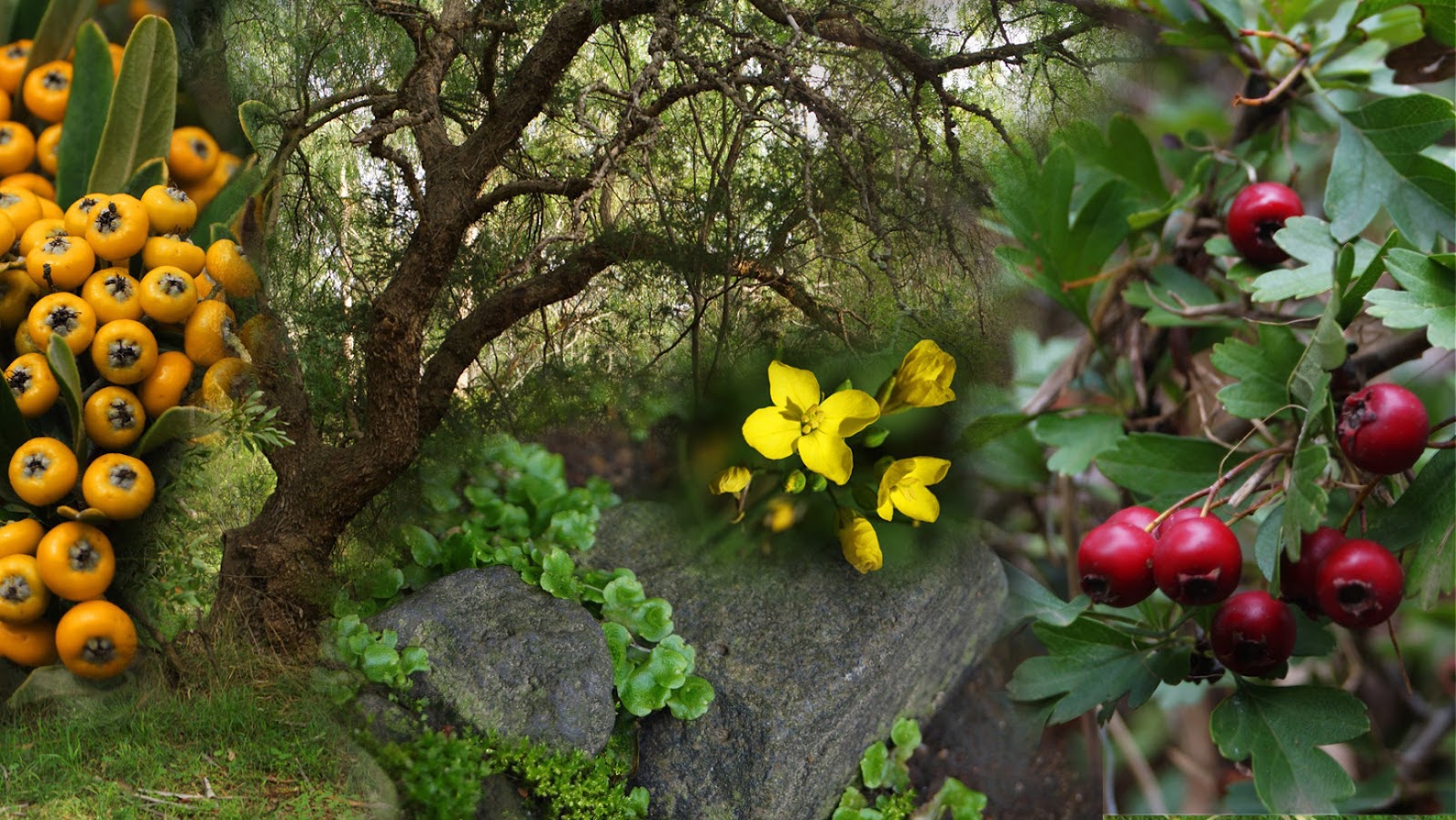
Yellow Pyracantha berries, canola flowers and red haws are always great to take photos of. When you can't get them all in frame as they are too far apart, create a mosaic with fuzzy borders in Photoshop!

This post is part of the Mosaic Monday meme,
and also part of the Macro Monday meme,
and also part of the Seasons meme.


Sunday, 15 September 2019

Thursday, 20 June 2019

FRANGIPANI

Plumeria is a genus of flowering plants in the dogbane family, Apocynaceae. It contains primarily deciduous shrubs and small trees. They are native to Central America, Mexico, the Caribbean, and South America as far south as Brazil but can be grown in tropical and sub-tropical regions. Plumeria is related to the Oleander, Nerium oleander, and both possess an irritant, rather similar to that of Euphorbia. Contact with the sap may irritate eyes and skin. 

Each of the separate species of Plumeria bears differently shaped, alternate leaves with distinct form and growth habits. The leaves of P. alba are quite narrow and corrugated, whereas leaves of P. pudica have an elongated shape and glossy, dark-green colour. P. pudica is one of the everblooming types with non-deciduous, evergreen leaves. Another species that retains leaves and flowers in winter is P. obtusa; though its common name is "Singapore," it is originally from Colombia.

Plumeria flowers are most fragrant at night in order to lure sphinx moths to pollinate them. The flowers have no nectar, however, and simply dupe their pollinators. The moths inadvertently pollinate them by transferring pollen from flower to flower in their fruitless search for nectar. Plumeria species may be propagated easily from cuttings of leafless stem tips in spring. Cuttings are allowed to dry at the base before planting in well-drained soil. Cuttings are particularly susceptible to rot in moist soil.

In order to get the most from a plumeria plant with respect to growth, size, blooms, and scent, there is a fine balance that must be maintained. Ideally, a plumeria is in its element when it can have plenty of sun and appropriate water, so as to maintain soil moistness just above a state of dryness. On the other hand, if the plant receives a lesser amount of sun, then a lesser amount of watering is necessary - again, to ensure that soil moistness stays just above the dry state. The more sun, the more water. The less sun, the less water. A common mistake of novice plumeria growers is to overwater the plant when it is not able to be exposed to enough sun, thereby resulting in a rotted root system. Conversely, if a plumeria plant is able to receive maximum exposure to the sun, but they aren't watered enough, the plant will die.

This post is part of the Floral Friday Fotos meme.

Sunday, 23 December 2018

CHRISTMAS BUSH

Ceratopetalum gummiferum, the New South Wales Christmas Bush, is a tall shrub or small tree popular in cultivation due to its sepals that turn bright red-pink at around Christmas time. The petals are actually small and white - it is the sepals that enlarge to about 12mm after the flower sets fruit and starts to dry out. The specific name gummiferum alludes to the large amounts of gum that is discharged from cut bark.

Plants initially grow as rounded shrubs but mature to pyramidical trees. The leaves comprise three leaflets and are up to 8 cm long. The petioles are grooved on the upper side and are 10 to 20 mm long. Small, white five-petalled flowers appear in spays from October in the species native range. As these die the sepals enlarge and become pink to red in colour, the display peaking at Christmas time in Australia (i.e. during Summer).

Ceratopatalum gummiferum is one of nine species in the genus Ceratopetalum int eh family Cunoniaceae, which occur in Australia and Papua New Guinea. The species was first formally described by English botanist James Edward Smith in 1793 in 'A Specimen of the Botany of New Holland'.

The species is endemic to New South Wales where it occurs to the east of the Great Dividing Range from Ulladulla in the south to Evans Head in the north. In cultivation, plants usually grow to no more than 6 metres in height. Plants may be propagated from seed or cuttings, the latter method being preferred to maintain good colour forms. Well-drained soil is required to avoid problems with dieback associated with root-rot fungus.

This post is part of the My Sunday Best meme,
and also part of the My Sunday Photo meme.