Thursday, 24 November 2022

CAMPANULA

Campanula glomerata 'Emerald' is a clustered bellflower that offers an interesting colour departure -- the flowers are sky blue to lavender blue with occasional darker flecks of purple-blue along the edges of the petals. The foliage is a lush emerald green.  An unusual cut flower and will rebloom if deadheaded.

This post is part of the Floral Friday Fotos meme


Thursday, 17 November 2022

RHODODENDRON

Rhododendron (from Ancient Greek ῥόδον rhódon "rose" and δένδρον déndron "tree") is a genus of 1,024 species of woody plants in the heath family (Ericaceae), either evergreen or deciduous, and found mainly in Asia, although it is also widespread throughout the highlands of the Appalachian Mountains of North America. 

It is the national flower of Nepal. Most species have brightly coloured flowers which bloom from late winter through to early summer. Azaleas make up two subgenera of Rhododendron. They are distinguished from "true" rhododendrons by having only five anthers per flower.

This post is part of the Floral Friday Fotos meme


Thursday, 3 November 2022

TEA TREE

Leptospermum scoparium, commonly called mānuka, mānuka myrtle, New Zealand teatree, broom tea-tree, or just tea tree, is a species of flowering plant in the myrtle family Myrtaceae, native to New Zealand (including the Chatham Islands) and south-east Australia. Its nectar produces Mānuka honey.

This post is part of the Floral Friday Fotos meme


Thursday, 27 October 2022

LILIUM

Lilium ‘Tiny Double You’ is a dwarf Asiatic lily (Plant number: 1.318.840) and one of the Lily Looks™ series developed in the Netherlands. Bred originally for containers, these are versatile garden plants as well. The dwarf habit makes them useful near the front of any sunny border where they put on a great midsummer show. Also equally at home in a rock garden. The best effect comes from massing in good-sized clumps of one variety.

This selection is unique and new to the series with large, upfacing double, orange flowers. It is an outstanding garden plant and its unlicensed propagation is prohibited! It is suited to a full sun or partial shade position and will grow in most soil types. It grows to 30-35 cm and blooms in mid-summer. It is deer-resistant and does well in rockeries, borders, massed displays and in containers.

This post is part of the Floral Friday Fotos meme. 


Thursday, 13 October 2022

CROWEA

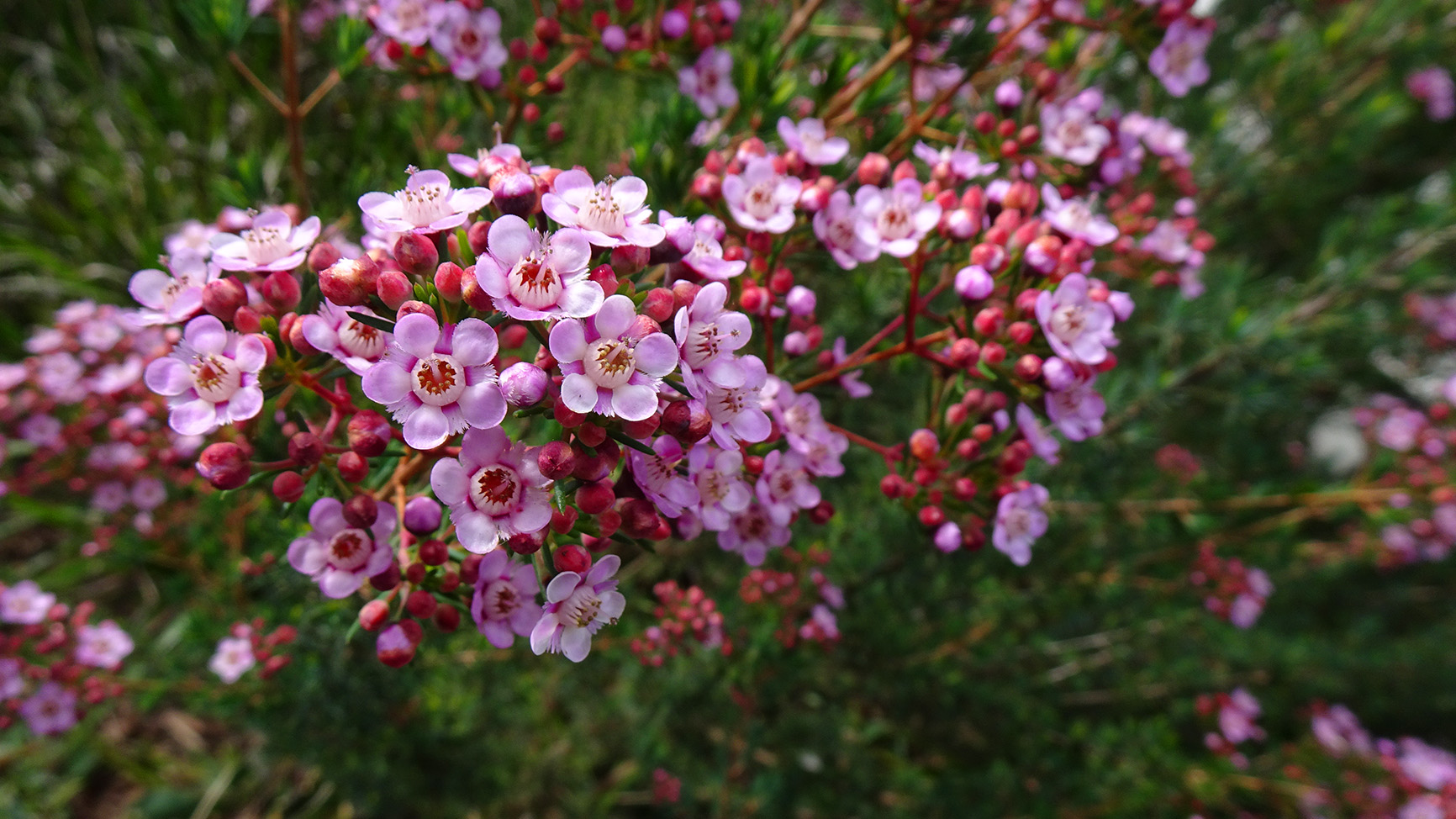
Crowea exalata, or Small Crowea, is a flowering plant in the family Rutaceae, which is native to the states of Queensland, New South Wales and Victoria in Australia. It is a small shrub growing to 1 metre tall. It is named after James Crowe, an 18th-19th century surgeon and botanist. The specific name exalata means without wings, referring to the lack of ridges on the stems - this is not a definitive characteristic.

This species flowers during most months of the year, resting only in extremes of heat and cold, and with flushes in autumn and spring. Pointed buds open to five-petalled starry flowers 2 cm across, in clear tints of rose purple. They are of a solid waxy substance, and make a vivid display for the size of the plant. Before falling they close again to look like buds of deeper pink.

Propagation by cuttings is easy using tip growth (which is very soft in character), at a half-ripe stage. Nurseries dealing in native plants usually stock this small shrub and it should be planted in light, lime-free soil. A position with some shade is desirable - otherwise the soil should be shaded in some way from hot sun. This may be done by surrounding the plant with 5-10 cm of leaves, bush litter or compost. Rocks make an attractive setting, and in fact this is a beautiful rockery subject.

Pruning should be done to maintain bushy growth, or a straggly plant with bare stems may develop. The end of winter is a good time to do this - or any time when sprigs of cut flowers are wanted, as these are dainty and long-lasting in water.

This post is part of the Floral Friday Fotos meme.


Saturday, 24 September 2022

EASTERN ROSELLA

The eastern rosella (Platycercus eximius) is a rosella native to southeast of the Australian continent and to Tasmania. It has been introduced to New Zealand where feral populations are found in the North Island (notably in the northern half of the island and in the Hutt Valley) and in the hills around Dunedin in the South Island.

The eastern rosella is 30 cm long. It has a red head and white cheeks. The beak is white and the irises are brown. The upper breast is red and the lower breast is yellow fading to pale green over the abdomen. The feathers of the back and shoulders are black, and have yellowish or greenish margins giving rise to a scalloped appearance that varies slightly between the subspecies and the sexes. The wings and lateral tail feathers are bluish while the tail is dark green. The legs are grey. The female is similar to the male though duller in colouration and has an underwing stripe, which is not present in the adult male. Juveniles are duller than females and have an underwing stripe.

The diet of eastern rosellas mainly consists of fruit, seeds, flowers and insects. The eastern rosella is sometimes kept as a pet. These birds are desired for their beautifully coloured plumage. They are intelligent creatures, which can be trained to whistle a wide repertoire of tunes and may even learn to speak a few words or phrases. Rosellas can make good companion parrots; however, they require a great deal of attention and many toys to satisfy their need for social interaction and mental stimulation.

These birds sometimes won't adapt to life as a family pet. Hand-raised birds can be fully domesticated, but usually they turn out still wild. Usually, this species doesn't like getting “petted” or “cuddled” and can bite in response to this type of handling. Many people believe that rosellas are best housed in large aviaries that enable them to fly freely with minimal human socialization. Despite these difficulties, many people enjoy the eastern rosella as a beautiful but sometimes feisty pet bird.

This post is part of the Saturday Critters meme.
and also part of the My Sunday Best meme.