Thursday, 23 February 2023

ROSE GERANIUM

Pelargonium graveolens is an uncommon Pelargonium species native to the Cape Provinces and the Northern Provinces of South Africa, Zimbabwe and Mozambique. It is in the subgenus Pelargonium along with Pelargonium crispum, Pelargonium tomentosum and Pelargonium capitatum.

Pelargonium graveolens is an erect, multi-branched shrub, that grows up to 1.5 m and has a spread of 1 m. The leaves are deeply incised, velvety and soft to the touch (due to glandular hairs). The flowers vary from pale pink to almost white and the plant flowers from August to January. The leaves may be strongly rose-scented, although the leaf shape and scent vary. Some plants are very strongly scented and others have little or no scent. Some leaves are deeply incised and others less so, being slightly lobed like P. capitatum.

This post is part of the Floral Friday Fotos meme.

Thursday, 9 February 2023

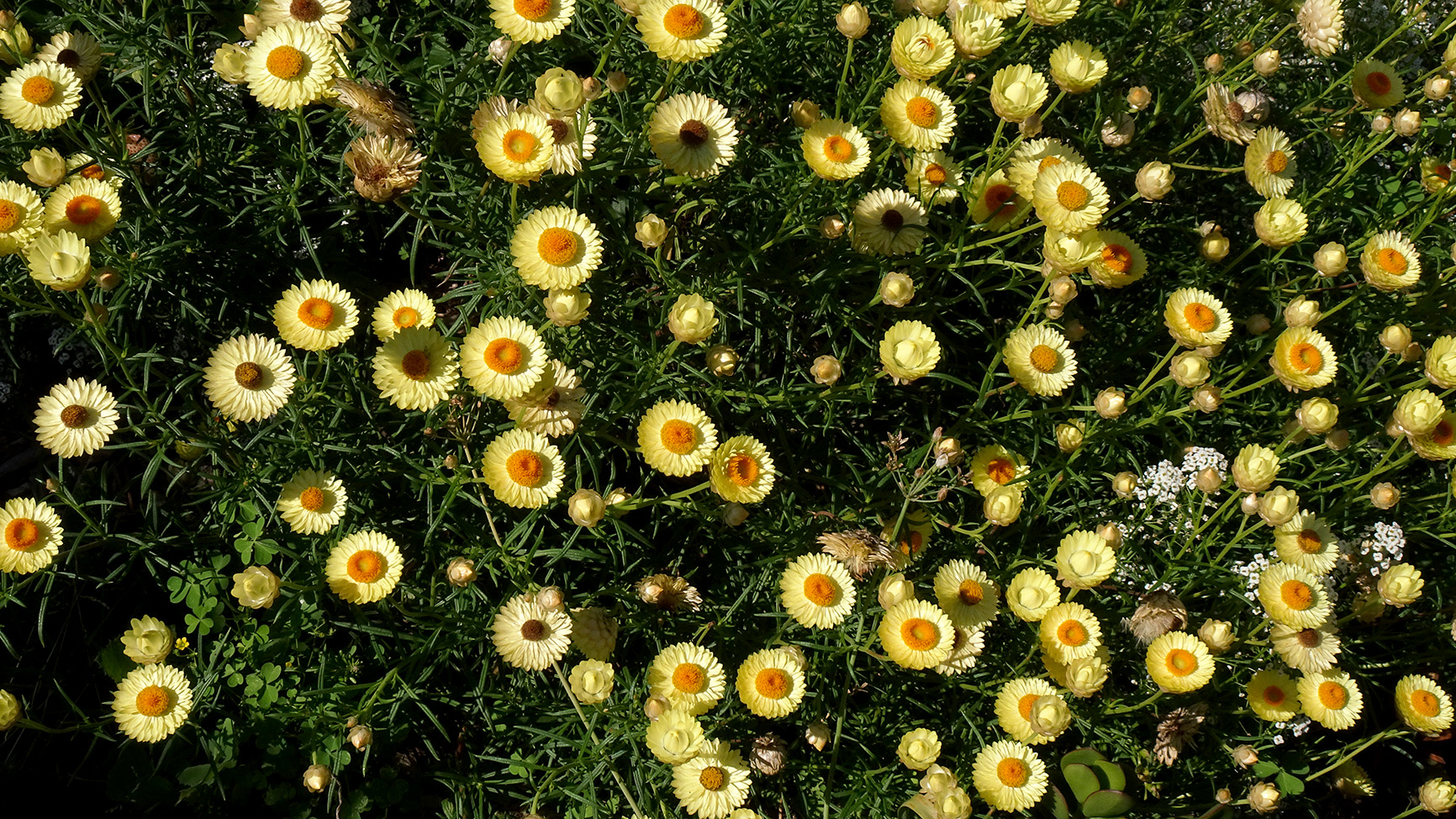
GOLDEN EVERLASTING

Xerochrysum bracteatum, commonly known as the golden everlasting or strawflower, is a flowering plant in the family Asteraceae native to Australia. Described by Étienne Pierre Ventenat in 1803, it was known as Helichrysum bracteatum for many years before being transferred to a new genus Xerochrysum in 1990.

It grows as a woody or herbaceous perennial or annual shrub up to a metre tall with green or grey leafy foliage. Golden yellow or white flower heads are produced from spring to autumn; their distinctive feature is the papery bracts that resemble petals. The species is widespread, growing in a variety of habitats across the country, from rainforest margins to deserts and subalpine areas.

This post is part of the Floral Friday Fotos meme


Thursday, 2 February 2023

DAY LILY

A daylily or day lily is a flowering plant in the genus Hemerocallis, a member of the family Asphodelaceae, subfamily Hemerocallidoideae. Despite the common name, it is not in fact a lily. Gardening enthusiasts and horticulturists have long bred daylily species for their attractive flowers. Thousands of cultivars have been registered by local and international Hemerocallis societies. Daylilies are perennial plants, whose name alludes to its flowers, which typically last about a day.

This post is part of the Floral Friday Fotos meme


Thursday, 26 January 2023

ERYNGIUM

Eryngium is a genus of flowering plants in the family Apiaceae. There are about 250 species. The genus has a cosmopolitan distribution, with the centre of diversity in South America. Common names include eryngo and amethyst sea holly (though the genus is not related to the true hollies, Ilex).

These are annual and perennial herbs with hairless and usually spiny leaves. The dome-shaped umbels of steely blue or white flowers have whorls of spiny basal bracts. Some species are native to rocky and coastal areas, but the majority are grassland plants. In the language of flowers, they represent "admiration".

Illustrated here is Eryngium x zabelii ‘Big Blue’, a common garden and cut flower. It produces especially large heads of steel-blue prickly flowers over a mound of silvery leaves that add texture to the sunny border. Exceptionally good for cutting, fresh or dried. Plants are mid-sized in habit with strong stems. A versatile plant, fitting well into the border and also useful in containers. Drought tolerant once established. Sea Holly is an easy-care perennial that adapts well to most sunny areas with average to dry soil. Remove old stems to ground level in late Autumn or early Spring.

This post is part of the Floral Friday Fotos meme.


Thursday, 19 January 2023

Thursday, 12 January 2023

PINK HIBISCUS

Hibiscus rosa-sinensis, known colloquially as Chinese hibiscus, China rose, Hawaiian hibiscus, and shoeblackplant, is a species of tropical hibiscus, a flowering plant in the Hibisceae tribe of the family Malvaceae, native to East Asia. Hibiscus rosa-sinensis is a bushy, evergreen shrub or small tree growing 2.5–5 m tall and 1.5–3 m wide, with glossy leaves and solitary, brilliant red flowers in summer and autumn. The 5-petaled flowers are 10 cm in diameter, with prominent orange-tipped red anthers. Numerous hybrids have been developed in a variety of flower colours, such as this fine pink specimen.

This post is part of the Floral Friday Fotos meme


Thursday, 5 January 2023

CHINESE PLUMBAGO

Ceratostigma willmottianum or Chinese plumbago is a deciduous shrub that provides great interest in early autumn when its slender stems bear pale blue flowers amongst the foliage that gradually turns red as the autumn season develops. This shrub is easy to grow in a sunny, well-drained spot and can be cut hard back in the spring where it can be utilised at the front of beds and borders in small or large gardens. The flowers are very attractive to butterflies.

This post is part of the Floral Friday Fotos meme.


Thursday, 29 December 2022

KURRAJONG

Brachychiton acerifolius, commonly known as the Illawarra Flame Tree, is a large tree of the family Malvaceae native to subtropical regions on the east coast of Australia. It is famous for the bright red bell-shaped flowers that often cover the whole tree when it is leafless. Along with other members of the genus Brachychiton, it is commonly referred to as a Kurrajong.

Brachychiton acerifolius was first described in 1855 by W. Macarthur and C. Moore. It is sometimes spelled as Brachychiton acerifolium, under the assumption that the genus name Brachychiton is (Greek) neuter. In fact, Brachychiton is masculine, and hence the correct species epithet is acerifolius. The name Brachychiton is derived from the Greek brachys, meaning short, and chiton, a type of tunic, as a reference to the coating on the seed. The specific epithet acerifolius suggests the appearance of the foliage is similar to that of the genus Acer, the maples.

This tree is tolerant of temperate climates and is now cultivated world-over for its beauty. However, the maximum height of 40 metres is reached only in the original, warmer, habitat. It usually grows to be about 20 metres. Similarly to its Kurrajong relatives the leaves are variable, with up to 7 deep lobes. It is deciduous - shedding its leaves after the dry season. The spectacular flowering occurs in late spring and new foliage is ready for the summer rains. In areas where the winter is not particularly dry, this natural rhythm may become somewhat erratic and the tree may flower only partially.

Flowers are scarlet bells with 5 partially fused petals. The pod-like fruits (technically known as follicles) are dark brown, wide, boat-shapes and about 10 cm long. They contain masses of thin bristles that stick in the skin, as well as yellow seeds. These are nutritious and were eaten by Aborigines after toasting. 

This post is part of the Floral Friday Fotos meme.


Thursday, 22 December 2022

ROSEMARY

Rosmarinus officinalis, commonly known as rosemary, is a woody, perennial herb with fragrant, evergreen, needle-like leaves and white, pink, purple, or blue flowers, native to the Mediterranean region. It is a member of the mint family Lamiaceae, which includes many other herbs. The name "rosemary" derives from the Latin for "dew" (ros) and "sea" (marinus), or "dew of the sea". The plant is also sometimes called anthos, from the ancient Greek word ἄνθος, meaning "flower".

This post is part of the Floral Friday Fotos meme.