
Showing posts with label perennial. Show all posts
Showing posts with label perennial. Show all posts
Thursday, 10 August 2023

Thursday, 27 July 2023

Thursday, 9 February 2023
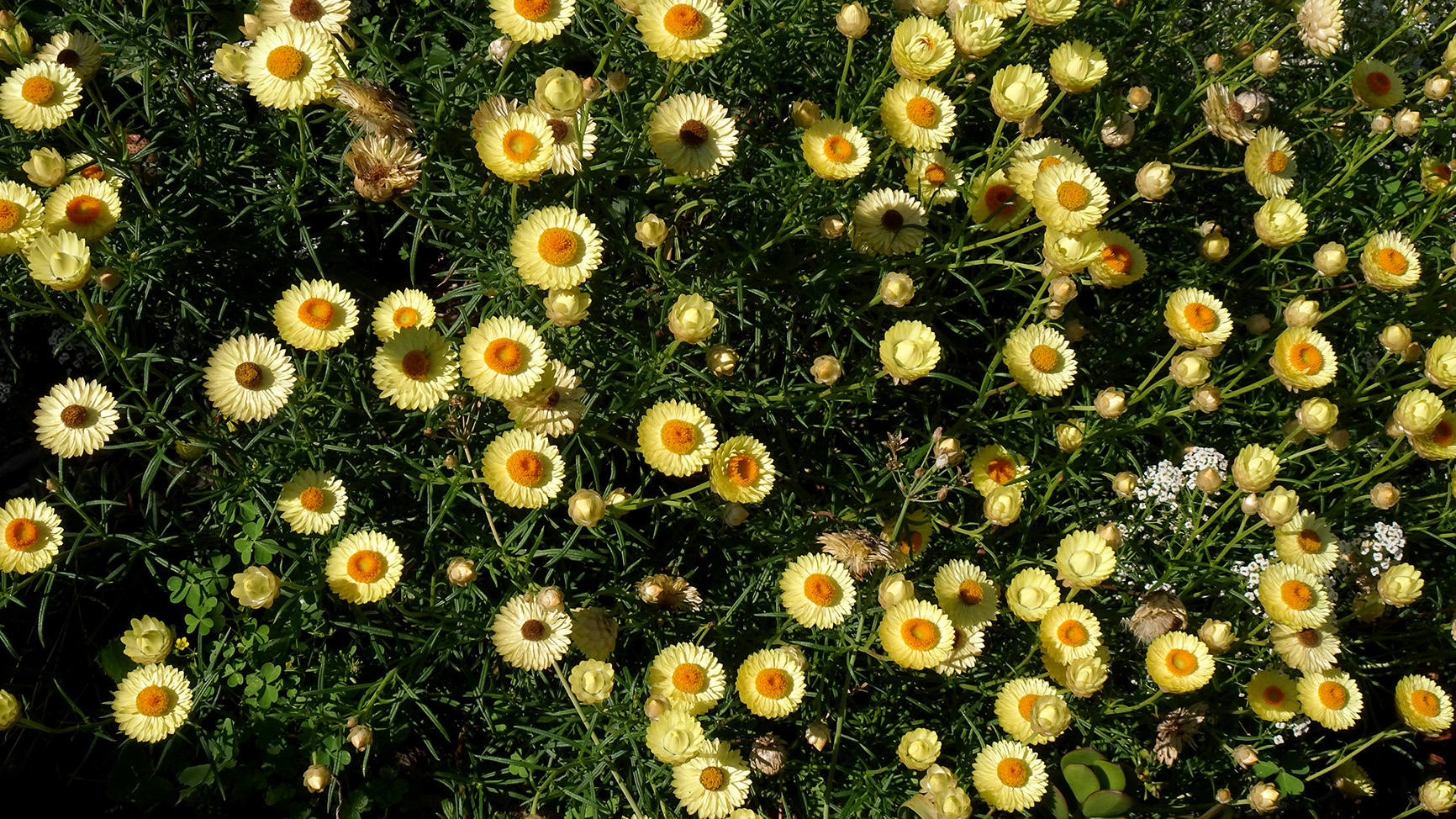
GOLDEN EVERLASTING
Xerochrysum bracteatum, commonly known as the golden everlasting or strawflower, is a flowering plant in the family Asteraceae native to Australia. Described by Étienne Pierre Ventenat in 1803, it was known as Helichrysum bracteatum for many years before being transferred to a new genus Xerochrysum in 1990.

It grows as a woody or herbaceous perennial or annual shrub up to a metre tall with green or grey leafy foliage. Golden yellow or white flower heads are produced from spring to autumn; their distinctive feature is the papery bracts that resemble petals. The species is widespread, growing in a variety of habitats across the country, from rainforest margins to deserts and subalpine areas.
This post is part of the Floral Friday Fotos meme
Thursday, 2 February 2023
DAY LILY
A daylily or day lily is a flowering plant in the genus Hemerocallis, a member of the family Asphodelaceae, subfamily Hemerocallidoideae. Despite the common name, it is not in fact a lily. Gardening enthusiasts and horticulturists have long bred daylily species for their attractive flowers. Thousands of cultivars have been registered by local and international Hemerocallis societies. Daylilies are perennial plants, whose name alludes to its flowers, which typically last about a day.

This post is part of the Floral Friday Fotos meme

Thursday, 24 February 2022
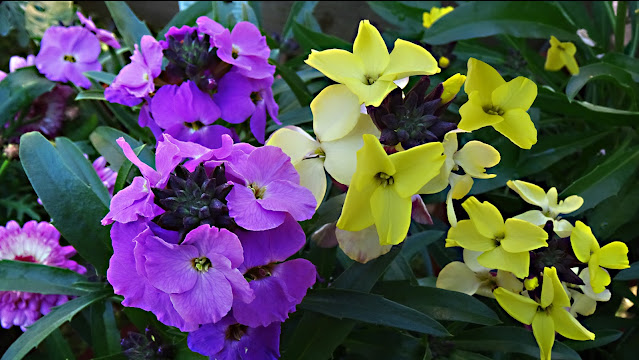
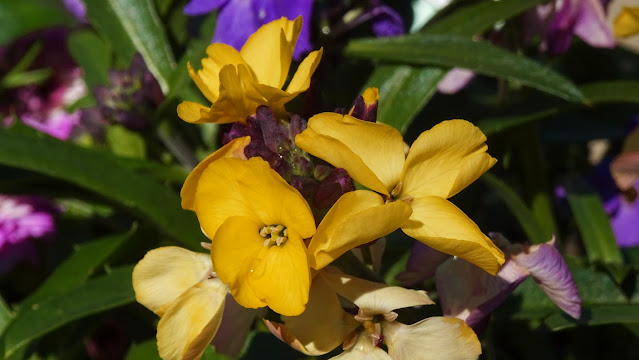
WALLFLOWERS
Erysimum cheiri syn. Cheiranthus cheiri (common name "wallflower") is a species of flowering plant in the family Brassicaceae (Cruciferae), native to Europe but widespread as an introduced species elsewhere. It is also widely cultivated as a garden plant. This is a herbaceous perennial, often grown as a biennial, with one or more highly branching stems reaching heights of 15–80 cm. The leaves are generally narrow and pointed and may be up to 20 cm long.
The top of the stem is occupied by a club-shaped inflorescence of strongly scented flowers. Each flower has purplish-green sepals and rounded petals which are two to three cm long and in shades of bright yellows to reds and purples. The flowers fall away to leave long fruits which are narrow, hairy siliques several cm in length. This is a popular ornamental plant, widely cultivated for its abundant, fragrant flowers in spring.
Many cultivars have been developed, in shades of yellow, orange, red, maroon, purple, brown, white and cream. It associates well in bedding schemes with other spring flowers such as tulips and forget-me-nots. It is usually grown as a biennial, sown one year to flower the next, and then discarded. This is partly because of its tendency to grow spindly and leggy during its second year, but more importantly its susceptibility to infections such as clubroot.
This post is part of the Floral Friday Fotos meme.


Thursday, 20 January 2022
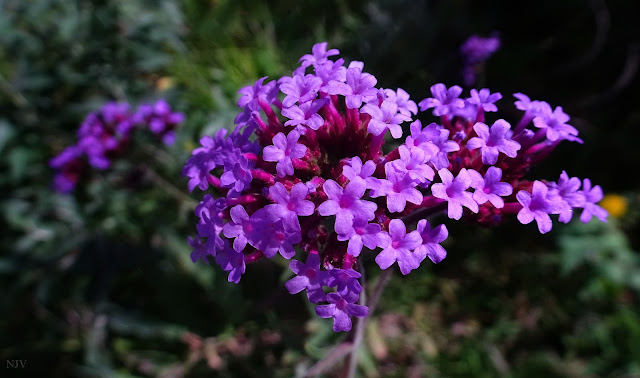
VERVAIN
Verbena rigida, known as slender vervain or tuberous vervain, is a flowering herbaceous perennial plant in the family Verbenaceae. It is native to Brazil and Argentina, and is not fully hardy in temperate climates, where consequently it is grown from seed as an annual. Growing to 60 centimetres, it has a spreading habit, with stalkless toothed leaves and bright purple or magenta, scented flowers in summer. Numerous cultivars have been selected for garden use. The species has gained the Royal Horticultural Society's Award of Garden Merit.
This post is part of the Floral Friday Fotos meme.
Thursday, 16 September 2021
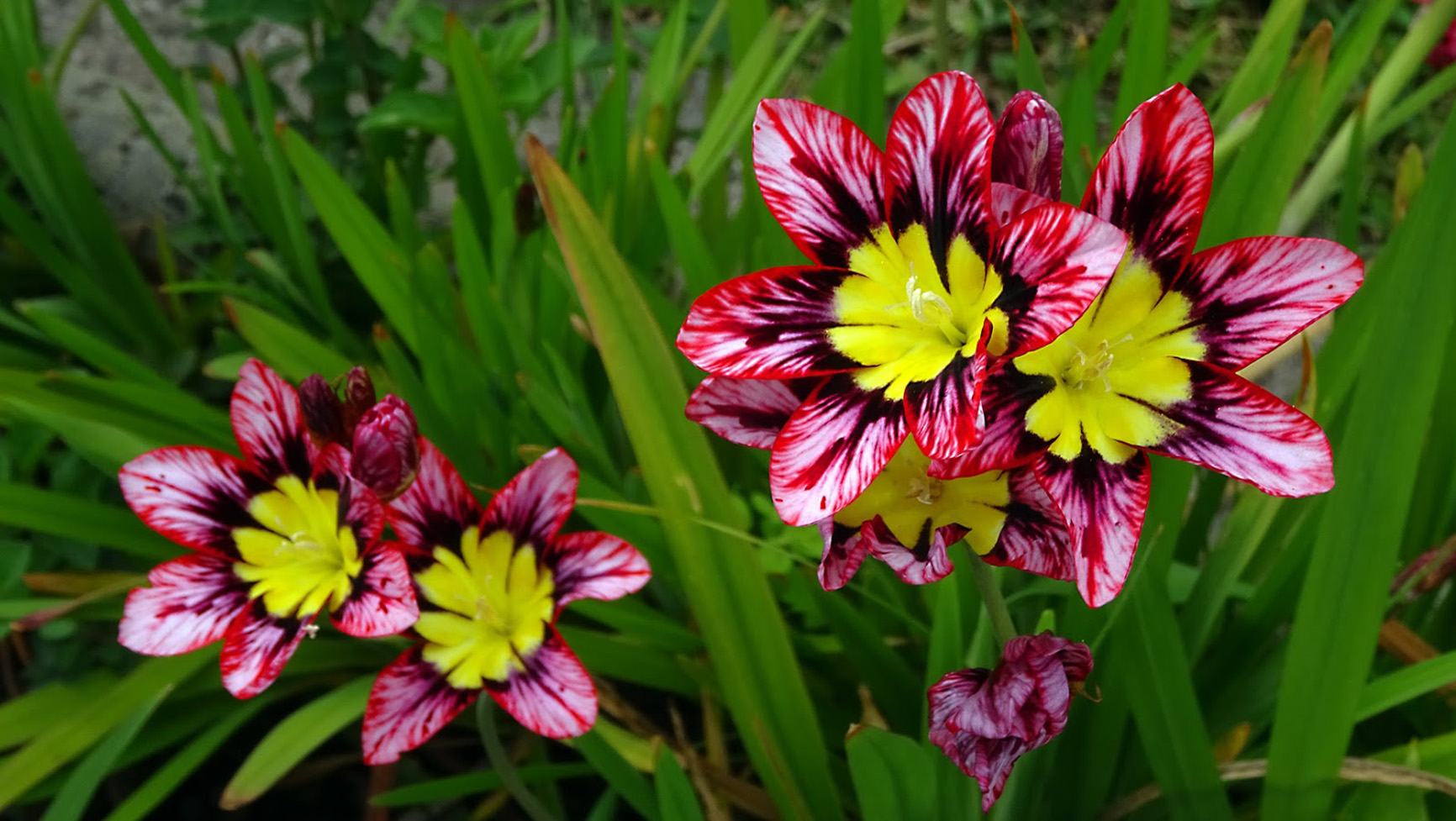
SPARAXIS
Sparaxis (harlequin flower) is a genus in the family Iridaceae with about 13 species endemic to Cape Province, South Africa. All are perennials that grow during the wet winter season, flower in spring and survive underground as dormant corms over summer. Their conspicuous flowers have six tepals, which in most species are equal in size and shape.
The genus name is derived from the Greek word sparasso, meaning "to tear", and alludes to the shape of the floral bracts. Sparaxis tricolor, known by the common names wandflower, harlequin flower, and sparaxis, is a bulb-forming perennial plant that grows in well-drained sunny soil.
It gained its common name from its colourful flowers which are bi- or tri-coloured with a golden centre and a small ring of brown surrounded by another colour. Although the plant is native to southern Africa. It is present in California and Australia as an introduced species after having escaped from garden cultivation.
This post is part of the Floral Friday Fotos meme
Thursday, 25 February 2021
GEUM
Geum commonly called avens, is a genus of about 50 species of rhizomatous perennial herbaceous plants in the Rosaceae family, widespread across Europe, Asia, North and South America, Africa, and New Zealand. They are closely related to Potentilla and Fragaria.
From a basal rosette of leaves, they produce flowers on wiry stalks, in shades of white, red, yellow, and orange, in midsummer. Geum species are evergreen except where winter temperatures drop below −18 °C. Geum species are used as food plants by the larvae of some Lepidoptera species including the grizzled skipper.
The cultivars 'Lady Stratheden' (shown here), and 'Mrs J. Bradshaw' have gained the Royal Horticultural Society's Award of Garden Merit.
This post is part of the Floral Friday Fotos meme.

Thursday, 11 February 2021
OREGANO
Oregano (Origanum vulgare) is a common species of Origanum, a genus of the Lamiaceae (mint) family. It is native to temperate western and southwestern Eurasia and the Mediterranean region. Oregano is a perennial herb, growing from 20–80 cm tall, with opposite leaves 1–4 cm long. Oregano will grow in a pH range between 6.0 (mildly acidic) and 9.0 (strongly alkaline), with a preferred range between 6.0 and 8.0. It is sometimes called wild marjoram, and its close relative Origanum majorana is known as sweet marjoram.
The flowers are purple, 3–4 mm long, produced in erect spikes. It has spade-shaped, olive-green leaves. It is a perennial, although it is grown as an annual in colder climates, as it often does not survive the winter. Oregano is planted in early spring, the plants being spaced 30 cm apart in fairly dry soil, with full sun. It prefers a hot, relatively dry climate, but does well in other environments.
Many subspecies and strains of oregano have been developed by humans over centuries for their unique flavours or other characteristics. Tastes range from spicy or astringent to more complicated and sweet. Simple oregano sold in garden stores as Origanum vulgare may have a bland taste and larger, less dense leaves, and is not considered the best for culinary uses, with a taste less remarkable and pungent. It can pollinate other more sophisticated strains, but the offspring are rarely better in quality. The related species, Origanum onites (Greece, Turkey) and O. syriacum (West Asia), have similar flavours. Some varieties show a flavour intermediate between oregano and marjoram.
The ‘Greek Kaliteri’ cultivar is a small, hardy, dark, compact plant with thick, silvery-haired leaves, usually with purple undersides. It has an excellent reputation for flavour and pungency, as well as medicinal uses, with a strong, archetypal oregano flavour (in Greek i kaliteri means ‘the best’).
Oregano is an important culinary herb, used for the flavour of its leaves, which can be more flavourful when dried than fresh. It has an aromatic, warm, and slightly bitter taste, which can vary in intensity. Good-quality oregano may be strong enough almost to numb the tongue, but cultivars adapted to colder climates often have a lesser flavour. Factors such as climate, season, and soil composition may affect the aromatic oils present, and this effect may be greater than the differences between the various species of plants.
This post is part of the Floral Friday Fotos meme

Thursday, 3 December 2020
POLEMONIUM
Attractive, dense ferny foliage makes Polemonium pulcherrimum 'Blue Dove' (also known as Jacob's ladder) a valuable plant for all year round interest in the garden. As an added bonus loose sprays of open bell shaped flowers in a soft shade of blue can appear from spring right through to and including autumn. Its 'lacy' appearance makes it a useful plant for softening hard lines and edges created by rocks, garden edging or paving.
Polemonium is a genus comprising of around 30 species of mostly perennial herbs which are native to regions of North and Central America, Europe and Asia. An excellent plant for general garden use and suitable for most colour schemes. 'Blue Dove' looks particularly at home in woodland type settings or in the cottage garden. It may be grown in semi shade although this may decrease flower production. This, however, is not necessarily a reason to avoid planting it in such locations as the attractive foliage alone will lend a visual appeal to these often difficult landscaping zones. To accent the foliage further create a foil of foliage behind it using larger, broader leafed plants or those with tall slender foliage such as that of Irises.
This post is part of the Floral Friday Fotos meme.

Thursday, 24 October 2019
CORAL 'GERANIUM'
We know them as simply 'geraniums'. They are one of the most popular container plants, yet they are not really geraniums at all. Botanically they are Pelargonium. There are true geraniums, the perennial cranesbills, but they look little like the annual plants we commonly call 'geraniums'.
The confusion with the names can be traced back to disagreements between botanists over classification and is of little importance to most gardeners, except for the distinction that perennial cranesbill geraniums will come back each year and zonal geraniums, those now classified as Pelargonium, are topical perennials usually grown as annuals in colder climates. They got the prefix "zonal" because of the markings on their leaves.
Zonal geraniums were discovered in South Africa and if you have a similar, subtropical climate, you can grow them as perennials. This coral pink zonal geranium is Pelargonium x hortorum. Zonal geraniums are bushy plants, mainly used for containers and bedding. There has been considerable breeding done, particularly for size and abundance and colours of flowers, so there is a good deal of variety. Zonal geraniums start blooming in mid-spring and will repeat bloom until frost. Deadheading the entire flower stalk after the flower fades will encourage more blooms.
This post is part of the Floral Friday Fotos meme.

Thursday, 10 October 2019
DAHLIA 'YORK & LANCASTER'
Dahlia is a genus of bushy, tuberous, herbaceous perennial plants native mainly in Mexico, but also Central America, and Colombia. A member of the Asteraceae (Compositae), dicotyledonous plants, related species include the sunflower, daisy, chrysanthemum and zinnia. There are at least 36 species of dahlia, with hybrids commonly grown as garden plants.
Flower forms are variable, with one head per stem; these can be as small as 5.1 cm diameter or up to 30 cm ("dinner plate"). This great variety results from dahlias being octoploids (that is, they have eight sets of homologous chromosomes), whereas most plants have only two. In addition, dahlias also contain many transposons (genetic pieces that move from place to place upon an allele), which contributes to their manifesting such great diversity.
The stems are leafy, ranging in height from as low as 30 cm to more than 1.8–2.4 m. The majority of species do not produce scented flowers or cultivars. Like most plants that do not attract pollinating insects through scent, they are brightly coloured, displaying most hues, with the exception of blue.The dahlia was declared the national flower of Mexico in 1963. The tubers were grown as a food crop by the Aztecs, but this use largely died out after the Spanish Conquest. Attempts to introduce the tubers as a food crop in Europe were unsuccessful.
The variety shown here, 'York & Lancaster' is an unusual and very beautiful dahlia whose origins in history have been lost centuries ago. As well as being of striking appearance, it is a cultivar that most dahlia experts have never heard of, while for others it's a genetic conundrum that shouldn't really exist. For a dahlia it is surprisingly tough, almost hardy in light soils. Standing approximately 2'6'' tall it produces large numbers of ball shaped flower heads. If it does throw up an occasional pure white flower it will always be followed by a brilliant white and carmine red bi-colour flower.
This post is part of the Floral Friday Fotos meme.

Thursday, 22 August 2019
BLUE ANGEL
Salvia patens 'Blue Angel' is a striking garden plant with delightful blue flowers. Since the 1838 discovery of this herbaceous species from Central Mexico, Salvia patens has been a mainstay of the perennial garden. Blue Angel is one of the smallest of the full-sized varieties of the so-called 'gentian sages'. Well branched and compact, this variety has 6 cm flowers that are a deep, royal blue and bloom from Summer into Autumn.
It is a reliable perennial, returning year after year in Zones 8 to 11. However, it is so lovely that it is worth growing as a summer bedding plant in colder zones. Blue Angel likes regular watering and rich, well-drained soil. It grows in full sun or partial shade and can handle moist corners of the garden. Use it as a path edging, border, ground-cover or container plant. British horticulturist Graham Stuart Thomas called Salvia patens 'the best plant in cultivation.'
This post is part of the Floral Friday Fotos meme.

Thursday, 13 June 2019
DELPHINIUM
Delphinium is a genus of about 300 species of perennial flowering plants in the family Ranunculaceae, native throughout the Northern Hemisphere and also on the high mountains of tropical Africa. All members of the Delphinium genus are toxic to humans and livestock. The common name "larkspur" is shared between perennial Delphinium species and annual species of the genus Consolida. The name "delphinium" derives from the Latin for "dolphin", referring to the shape of the nectary.
'Blue Sensation' hybrid, picture here, is a vigorous Delphinium that will rebloom up to five times after each successive flush when dead headed. Ideal in cottage gardens where it adds a dimension of height and colour. Growing to just under a metre, the strong, well branched stems of Delphinium 'Blue Sensation' are loaded with blooms through summer. Plant in a sunny location with well drained, humus rich soil and fertilise well. Delphinium 'Blue Sensation' can be enjoyed as a cut flower also. Plant Delphinium 'Blue Sensation' in moist, humus rich, well drained soil, that has well-rotted manure or compost worked into the soil prior to planting.
This post is part of the Floral Friday Fotos meme.

Thursday, 6 June 2019
CANARY ISLAND DAISY
Asteriscus sericeus (Canary Island Daisy) is a silver-foliaged shrub that grows to about metre tall by about 1.5 metres. It initially forms a dense mound, but with age has a more open structure. Foliage is soft and light greenish-silver with silky fuzzy hairs ('sericeus' means silky in Latin).
It belongs to the family Asteraceae. The yellow flowers are up to 6 cm across and appear in the summer months. It should be planted in full sun in a well-drained soil or on a mound and only watered sparingly . Although it is not a long lived plant (3-5 years), it will renew itself by seed. It is hardy to about -5˚C.
This post is part of the Floral Friday Fotos meme.

Wednesday, 23 January 2019
POLEMONIUM
Attractive, dense ferny foliage makes Polemonium pulcherrimum 'Blue Dove' (also known as Jacob's ladder) a valuable plant for all year round interest in the garden. As an added bonus loose sprays of open bell shaped flowers in a soft shade of blue can appear from spring right through to and including autumn. Its 'lacy' appearance makes it a useful plant for softening hard lines and edges created by rocks, garden edging or paving.
Polemonium is a genus comprising of around 30 species of mostly perennial herbs which are native to regions of North and Central America, Europe and Asia. An excellent plant for general garden use and suitable for most colour schemes. 'Blue Dove' looks particularly at home in woodland type settings or in the cottage garden. It may be grown in semi shade although this may decrease flower production. This, however, is not necessarily a reason to avoid planting it in such locations as the attractive foliage alone will lend a visual appeal to these often difficult landscaping zones. To accent the foliage further create a foil of foliage behind it using larger, broader leafed plants or those with tall slender foliage such as that of Irises.
This post is part of the Floral Friday Fotos meme.

Thursday, 22 March 2018
OSTEOSPERMUM 3D
Osteospermum eckloni is a daisy in the family Asteraceae. Common names: Cape marguerite, van Staden's River daisy, Sundays River daisy, white daisy bush, blue-and-white daisy bush (Eng.); Kaapse magriet, jakkalsbos, Vanstadensrivier madeliefie, Sondagsrivier madeliefie (Afr.)
Osteospermum eckloni is a perennial plant of up to 1 m tall and as much in diameter, erect to decumbent. It can get woody at the base. The leaves are alternately arranged, sessile, simple, elliptic and slightly succulent, and the margins are entire to conspicuously dentate, crowded at the ends of the branches. The lower branches are quite nude. NB: Dimorphotheca is the genus containing the annual Cape Marguerites.
These daisies must be planted in full sun in order for the flowers to open to their full potential, although they will tolerate some shade during the day. They can be mass-planted as a groundcover, as a border to a shrubbery, or to line pathways. Cape marguerite can be cultivated from cuttings taken in summer. Seed germinates easily and the plants often sow themselves. They are fast-growing, frost-hardy and drought-resistant. Plants should be cut back after the second year to keep them tidy, or be replaced by new plants. The peak flowering time is in spring but some flowers are always present on the plants throughout summer. There are no known garden pests that attack these plants.
The hybrid shown here is a "3D" series, which has a double flower appearance. They have a slightly raised bed of larger florets in the centre of the flower head that resemble a pom-pom. The flowers blooms stay open all day and all night and last from spring through to early autumn.
This post is part of the Floral Friday Fotos meme.
Osteospermum eckloni is a perennial plant of up to 1 m tall and as much in diameter, erect to decumbent. It can get woody at the base. The leaves are alternately arranged, sessile, simple, elliptic and slightly succulent, and the margins are entire to conspicuously dentate, crowded at the ends of the branches. The lower branches are quite nude. NB: Dimorphotheca is the genus containing the annual Cape Marguerites.
These daisies must be planted in full sun in order for the flowers to open to their full potential, although they will tolerate some shade during the day. They can be mass-planted as a groundcover, as a border to a shrubbery, or to line pathways. Cape marguerite can be cultivated from cuttings taken in summer. Seed germinates easily and the plants often sow themselves. They are fast-growing, frost-hardy and drought-resistant. Plants should be cut back after the second year to keep them tidy, or be replaced by new plants. The peak flowering time is in spring but some flowers are always present on the plants throughout summer. There are no known garden pests that attack these plants.
The hybrid shown here is a "3D" series, which has a double flower appearance. They have a slightly raised bed of larger florets in the centre of the flower head that resemble a pom-pom. The flowers blooms stay open all day and all night and last from spring through to early autumn.
This post is part of the Floral Friday Fotos meme.

Thursday, 23 February 2017
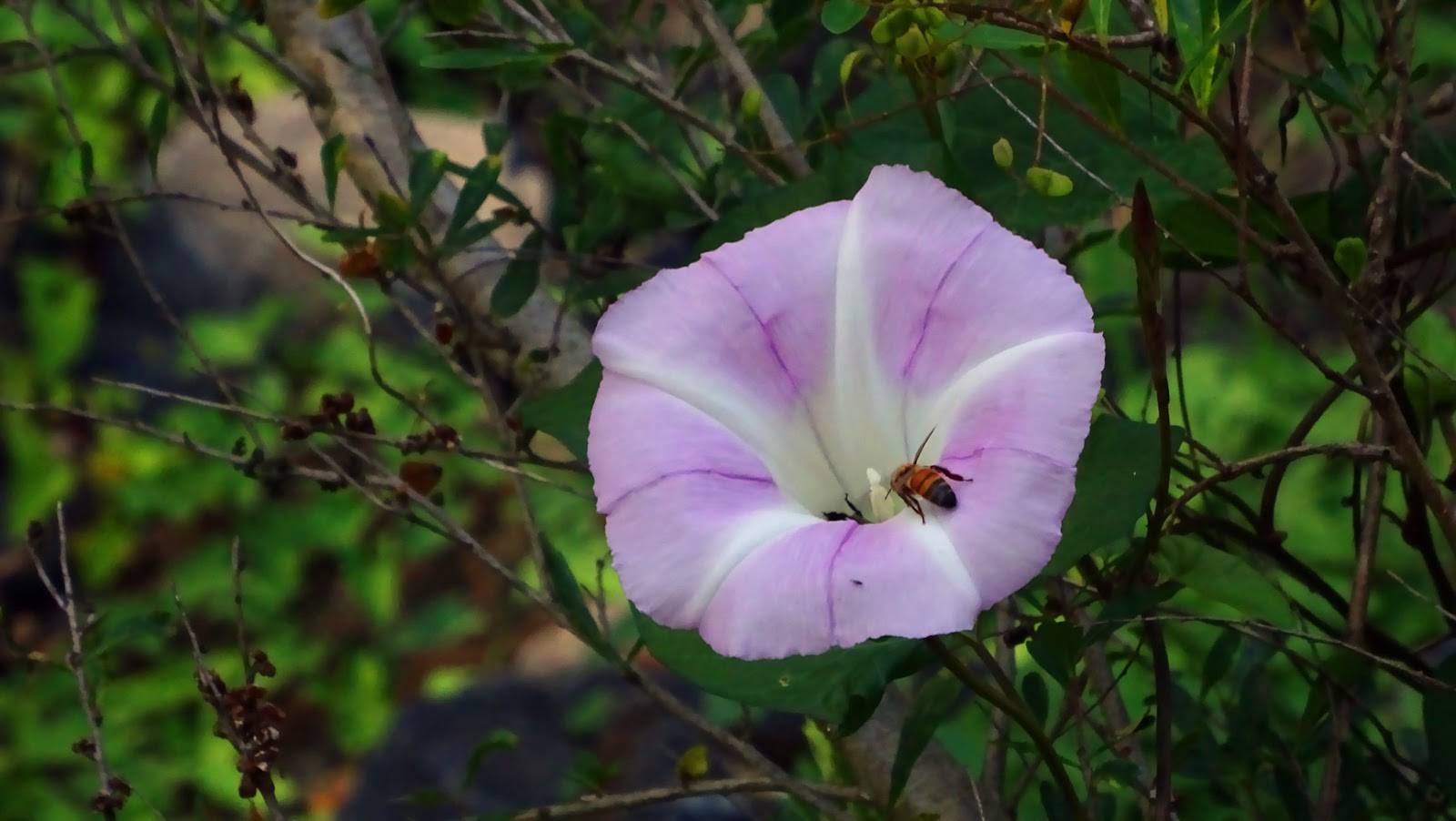
AUSTRALIAN BINDWEED
Convolvulus is a genus of about 200 to 250 species of flowering plants in the bindweed family Convolvulaceae, with a cosmopolitan distribution. Common names include bindweed and morning glory; both names shared with other closely related genera. They are annual or perennial herbaceous vines, bines and (a few species of) woody shrubs, growing to 0.3–3 m tall. The leaves are spirally arranged, and the flowers trumpet-shaped, mostly white or pink, but blue, violet, purple or yellow in some species. Many of the species are invasive species weeds; but others are cultivated for their attractive flowers, while some are globally threatened.
This is Convolvulus erubescens, commonly known as blushing bindweed, pinkflower bindweed or (in Britain and Ireland) Australian bindweed, is a perennial herb in the Convolvulaceae family that is native to Australia. It has trailing and twining stems and variable leaves, ovate to triangular or arrow-shaped, 25–55 mm long and 2–40 mm wide. It has rosy-pink or mauve, funnel-shaped flowers, 7–15 mm long, 8–20 mm in diameter, with a pale, greenish throat. It is found in coastal and subcoastal areas where it inhabits eucalypt forests, the margins of rainforests, grassy woodlands and grasslands.
Thursday, 25 February 2016
DELPHINIUM
Delphinium ‘Blue Bird’ is a Pacific Giant Delphinium in the family Ranunculaceae suitable for USDA Zones: 2-9. Delphiniums are the stars of the early summer border. Plants form a low mound of deeply-cut green leaves, bearing tall spikes of satiny flowers. This selection has beautiful clear blue petals, with a white centre, or “bee”. Removing faded spikes at the base will encourage repeat blooming in Autumn. In hot, humid summer regions, plants do not usually last more than 2 to 3 years. Plants are often attacked by mildew in mid summer; simply cut back hard to encourage fresh foliage. Use a high phosphorus fertiliser each year, in early spring. Take caution, as this plant is harmful if eaten!
This post is part of the Floral Friday Fotos meme.

This post is part of the Floral Friday Fotos meme.

Thursday, 19 February 2015
GIANT SPIDERWORT
Tradescantia, the Spiderworts, is a genus of 75 species of perennial plants in the family Commelinaceae, native to the New World from southern Canada south to northern Argentina including the West Indies. Some species have become naturalised in various regions in Europe, Asia, Africa, Australia and assorted oceanic islands.
They are weakly upright to scrambling plants, growing to 30–60 cm tall, and are commonly found individually or in clumps in wooded areas and fields. A number of the species flower in the morning and when the sun shines on the flowers in the afternoon they close, but can remain open on cloudy days until evening.
Tradescantia gigantea or Giant Spiderwort, has a dainty, three-petal flower with slender, hairy stamens. The flower colour can be an indicator of the pH of the soil. Acidic soils produce bluer flowers, while more alkaline soils create varying shades of pink and purple. All parts of this plant contain volatile oil that can cause severe skin inflammation, itching, and blistering on direct contact or if borne by sooty smoke. Washing thoroughly with soap or swabbing with alcohol immediately on exposure removes the oil irritant. The berries are poisonous if eaten.
This post is part of the Floral Friday Fotos meme.

They are weakly upright to scrambling plants, growing to 30–60 cm tall, and are commonly found individually or in clumps in wooded areas and fields. A number of the species flower in the morning and when the sun shines on the flowers in the afternoon they close, but can remain open on cloudy days until evening.
Tradescantia gigantea or Giant Spiderwort, has a dainty, three-petal flower with slender, hairy stamens. The flower colour can be an indicator of the pH of the soil. Acidic soils produce bluer flowers, while more alkaline soils create varying shades of pink and purple. All parts of this plant contain volatile oil that can cause severe skin inflammation, itching, and blistering on direct contact or if borne by sooty smoke. Washing thoroughly with soap or swabbing with alcohol immediately on exposure removes the oil irritant. The berries are poisonous if eaten.
This post is part of the Floral Friday Fotos meme.
Subscribe to:
Posts (Atom)