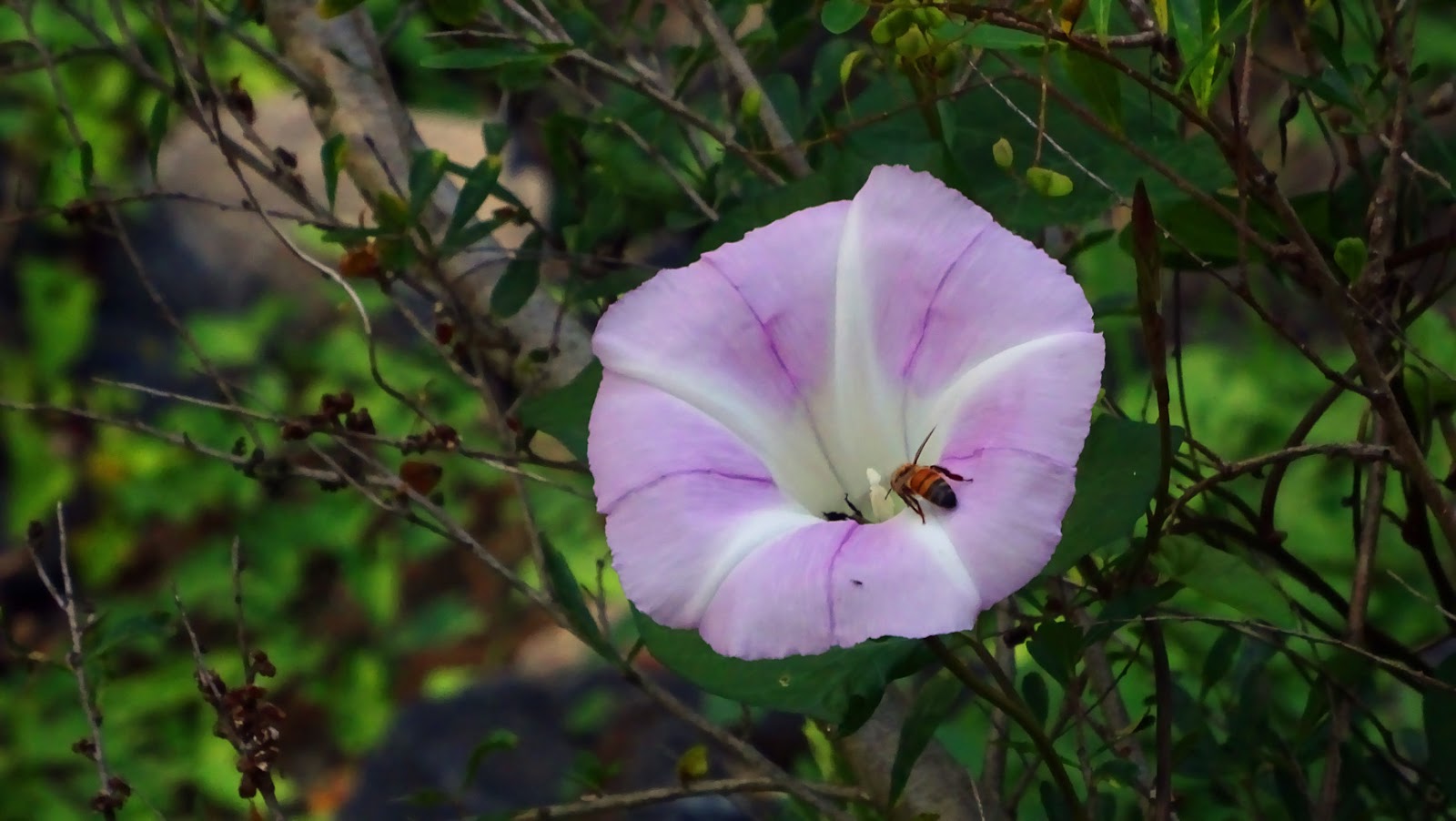
This is Convolvulus erubescens, commonly known as blushing bindweed, pinkflower bindweed or (in Britain and Ireland) Australian bindweed, is a perennial herb in the Convolvulaceae family that is native to Australia. It has trailing and twining stems and variable leaves, ovate to triangular or arrow-shaped, 25–55 mm long and 2–40 mm wide. It has rosy-pink or mauve, funnel-shaped flowers, 7–15 mm long, 8–20 mm in diameter, with a pale, greenish throat. It is found in coastal and subcoastal areas where it inhabits eucalypt forests, the margins of rainforests, grassy woodlands and grasslands.
Showing posts with label Convolvulaceae. Show all posts
Showing posts with label Convolvulaceae. Show all posts
Thursday, 23 February 2017
AUSTRALIAN BINDWEED
Convolvulus is a genus of about 200 to 250 species of flowering plants in the bindweed family Convolvulaceae, with a cosmopolitan distribution. Common names include bindweed and morning glory; both names shared with other closely related genera. They are annual or perennial herbaceous vines, bines and (a few species of) woody shrubs, growing to 0.3–3 m tall. The leaves are spirally arranged, and the flowers trumpet-shaped, mostly white or pink, but blue, violet, purple or yellow in some species. Many of the species are invasive species weeds; but others are cultivated for their attractive flowers, while some are globally threatened.

Thursday, 15 December 2016
FIELD BINDWEED
Convolvulus arvensis (field bindweed) is a species of bindweed in the morning glory family (Convolvulaceae), native to Europe and Asia. It is a climbing or creeping herbaceous perennial plant growing to 0.5–2 m high.
The leaves are spirally arranged, linear to arrowhead-shaped, 2–5 cm long and alternate, with a 1–3 cm petiole. The flowers are trumpet-shaped, 3-5 cm diameter, white or pale pink, with five slightly darker pink radial stripes. Flowering occurs in the mid-summer, when white to pale pink, funnel-shaped flowers develop. Fruit are light brown, rounded and 1/8 in. (0.3 cm) wide. Each fruit contains 2 seeds that are eaten by birds and can remain viable in the soil for decades.
Although it produces attractive flowers, it is often unwelcome in gardens as a nuisance weed due to its rapid growth and choking of cultivated plants. It was most likely introduced into North America as a contaminant in crop seed as early as 1739, as an invasive species. Plants typically inhabit roadsides, grasslands and also along streams. Its dense mats invade agricultural fields and reduce crop yields; it is estimated that crop losses due to this plant in the United States exceeded US$377 million in the year 1998 alone. In one of the tales collected by Jacob and Wilhelm Grimm, Our Lady's Little Glass, this flower is used by Our Lady to drink wine with when she helps free a wagoner's cart. The story goes on to say that "the little flower is still always called Our Lady's Little Glass."
Field bindweed intertwines and topples native species. It competes with other species for sunlight, moisture and nutrients. It poses threats to restoration efforts and riparian corridors by choking out grasses and forbs. It can decrease habitat biodiversity. It is one of the most serious weeds of agricultural fields in temperate regions of the world.
This post is part of the Floral Friday Fotos meme.

Subscribe to:
Posts (Atom)