Showing posts with label white. Show all posts

Thursday, 7 April 2022

CHINESE LANTERN

Abutilon or 'Chinese lanterns' are closely related to hibiscus, and most of the hundred or so species have pendulous, hibiscus-like flowers. Cultivars produced by hybridising some of the South American abutilons have all been placed in one group known as Abutilon x hybridum, and these are the ones most commonly grown in Australian gardens.

They have a wispy, delicate form and colourful, lantern-shaped flowers. For gardeners who prefer plants with a more dense habit, new compact varieties are also available. Another popular abutilon is Abutilon megapotamicum, which is a prostrate or ground covering species with small orange flowers. Abutilon are evergreen shrubs with attractive maple-like leaves and an open, pendulous habit. They grow to about 2-3 metres tall.

Flowers in the Southern Hemisphere are produced in September to December, but they spot flower at other times. Flower colours include white, pink, red, yellow, orange and salmon. These plants grow well in most parts of Australia, except for the very cold mountain zones. In inland areas be sure to water well and keep protected with mulch. In hot inland climates abutilons appreciate some light shade.

This post is part of the Floral Friday Fotos meme.


Thursday, 17 September 2020

OLEARIA

Olearia is a genus of flowering plants belonging to the family Asteraceae. There are about 130 different species within the genus found mostly in Australia, New Guinea and New Zealand. The genus includes herbaceous plants, shrubs and small trees. The latter are unusual among the Asteraceae and are called Tree daisies in New Zealand. All bear the familiar daisy-like composite flowerheads. The genus is named after Johann Gottfried Olearius, a 17th-century German scholar and author of Specimen Florae Hallensis.

Olearia phlogopappa, the dusty daisy-bush shown here, occurs in open forest, woodland, heath and coastal shrubland in New South Wales, Victoria, and Tasmania. It grows to between 0.3 and 3 metres in height. The leaves are quite variable, but are usually grey-green with minute hairs on the underside which impart a whitish or yellowish appearance. The leaf margins are often bluntly toothed. White, pink or mauve "daisy" flower heads around 20–25 mm in diameter are mainly produced in spring and early summer.

This post is part of the Floral Friday Fotos meme.


Sunday, 6 September 2020

MAGNOLIA & BEE

Magnolia grandiflora, commonly known as the southern magnolia or bull bay, is a tree of the family Magnoliaceae native to the southeastern United States, from Virginia south to central Florida, and west to eastern Texas and Oklahoma. Some trees have been viewed as far west as New Mexico and California. Reaching 27.5 m in height, it is a large striking evergreen tree with large dark green leaves and large white fragrant flowers. Widely cultivated around the world, over a hundred cultivars have been bred and marketed commercially. The timber is hard and heavy, and has been used commercially to make furniture, pallets, and veneer.

This post is part of the My Sunday Best meme.

Thursday, 28 May 2020

SEASIDE DAISY

Erigeron karvinskianus is a species of flowering plant in the family Asteraceae known by the common names Mexican fleabane, Latin American fleabane, Santa Barbara daisy, Spanish daisy, Karwinsky’s fleabane, or bony-tip fleabane. Erigeron karvinskianus is native to much of Mexico, Central America, Colombia and Venezuela, and is naturalized in many other places, including parts of Africa and Europe, Australia, Hong Kong, Chile and the west coast of the United States.

Erigeron karvinskianus was first described in 1836 by Augustin Pyramus de Candolle. The specific epithet refers to Wilhelm Friedrich Karwinski von Karwin, who collected the plant in Mexico according to de Candolle. It is a vigorous, spreading perennial plant growing from woody rhizomes to a maximum height of 15 cm. Its leaves are located along the stem, the basal leaves dying off as the plant bolts. They are sometimes slightly toothed or lobed near the tips. The inflorescences hold one or more flower heads which are each about 1 cm wide. They have golden yellow disc florets in the centre surrounded by a fringe of up to 80 white to pinkish ray florets.

Erigeron karvinskianus is cultivated for its daisy-like blooms, and is often confused with the closely related true daisy Bellis. It is frequently grown in crevices in walls or paving, where it rapidly spreads to provide a carpet of flowers. It has gained the Royal Horticultural Society's Award of Garden Merit. It was used to colonise the concrete terraces of the football stadium (Estadio Azteca) built in Mexico City for the 1970 World Cup.

This post is part of the Floral Friday Fotos meme.

Thursday, 20 February 2020

FOTHERGILLA

Fothergilla ‘Mount Airy’ is a hybrid Fothergilla cultivar that was discovered by plantsman Michael A. Dirr at the Mt. Airy Arboretum in Cincinnati, Ohio. This is a vigorous deciduous shrub that grows 1.5 m tall and is noted for its profuse spring flowering, excellent summer foliage, excellent Autumn colour and consistently upright habit.

Terminal, bottlebrush-like spikes (2-5 cm long) of tiny, fragrant, apetulous, white flowers bloom in mid- to late Spring after the foliage emerges. Flower colour comes from the dense clusters of showy stamens (white filaments and yellowish anthers). Flowers have a honey-scented frangance. Leathery, ovate to obovate leaves (4-10 cm long) are dark green above and bluish gray beneath.

Foliage turns excellent shades of yellow, orange and red-purple in Autumn. Genus name honours Dr. John Fothergill, 18th century English physician and early collector of American plants. ‘Mount Airy’ may be a cross between two southeastern U. S. natives, F. gardenii and F. major. It is taller than the former but shorter than the latter.

This post is part of the Floral Friday Fotos meme.


Thursday, 5 December 2019

ROBINIA

Robinia pseudoacacia, commonly known as the black locust, is a tree of the genus Robinia in the subfamily Faboideae of the pea family Fabaceae. It is native to the southeastern United States, but has been widely planted and naturalised elsewhere in temperate North America, Europe, Southern Africa, Australia and Asia and is considered an invasive species in some areas. A less frequently used common name is false Acacia, which is a literal translation of the specific epithet. It was introduced into Britain in 1636.

With a trunk up to 0.8 m diameter (exceptionally up to 52 m tall and 1.6 m diameter in very old trees), with thick, deeply furrowed blackish bark. The leaves are 10–25 cm long, pinnate with 9–19 oval leaflets, 2–5 cm long and 1.5–3 cm broad. Each leaf usually has a pair of short spines at the base, 1–2 mm long or absent on adult crown shoots, up to 2 cm long on vigorous young plants. The intensely fragrant (reminiscent of orange blossoms) flowers are white to lavender or purple, borne in pendulous racemes 8–20 cm long, and are edible. In France and in Italy Robinia pseudoacacia flowers are eaten as beignets after being coated in batter and fried in oil.

The fruit is a legume 5–10 cm long, containing 4–10 seeds. Although the bark and leaves are toxic, various reports suggest that the seeds and the young pods of the black locust are edible. Shelled seeds are safe to harvest from summer through fall, and are edible both raw and/or boiled. Due to the small nature of Black Locust seeds, shelling them efficiently can prove tedious and difficult. The name locust is said to have been given to Robinia by Jesuit missionaries, who fancied that this was the tree that supported St. John in the wilderness, but it is native only to North America. The locust tree of Spain (Ceratonia siliqua or Carob Tree), which is also native to Syria and the entire Mediterranean basin, is supposed to be the true locust of the New Testament.

This post is part of the Floral Friday Fotos meme.

Thursday, 7 November 2019

GIANT LILY

Cardiocrinum giganteum, the giant Himalayan lily, is the largest species of any of the lily plants, family Liliaceae, growing up to 3.5 metres high. It is found in the Himalayas, China and Myanmar (Burma). Two varieties are recognised: C. giganteum var. giganteum - up to 3 metres tall, the outer part of the flower greenish and the inside streaked with purple - Tibet, Bhutan, Assam, Myanmar, Nepal, Sikkim C. giganteum var. yunnanense - 1–2 metres tall, the outer part of the flower white and the inside streaked with purplish red - Myanmar, Gansu, Guangdong, Guangxi, Guizhou, Henan, Hubei, Hunan, Shaanxi, Sichuan, Yunnan. 

The plant was first described scientifically in 1824 by Nathaniel Wallich. The species was introduced into commercial production (as Lilium giganteum) in Britain in the 1850s. A bulb grown from seed collected by Major Madden flowered in Edinburgh in July 1852, while those collected by Thomas Lobb were first exhibited in flower in May 1853.

Cardiocrinum giganteum is a standout in any garden. With its flower stakes topping out at 3 metres and its ability to produce 20 heavily perfumed trumpet-shaped flowers, it is bound to be a focal point. Be prepared to be patient for these results; most bulbs take 3 to 4 years to settle in and bloom. During that time, while the bulb grows and expands, the plant earns its keep with attractive heart shaped leaves that are reminiscent of full size hostas. The bulb also develops offsets, or baby bulbs along the side of the mother, ensuring future blooms.

This post is part of the Floral Friday Fotos meme.

Thursday, 1 August 2019

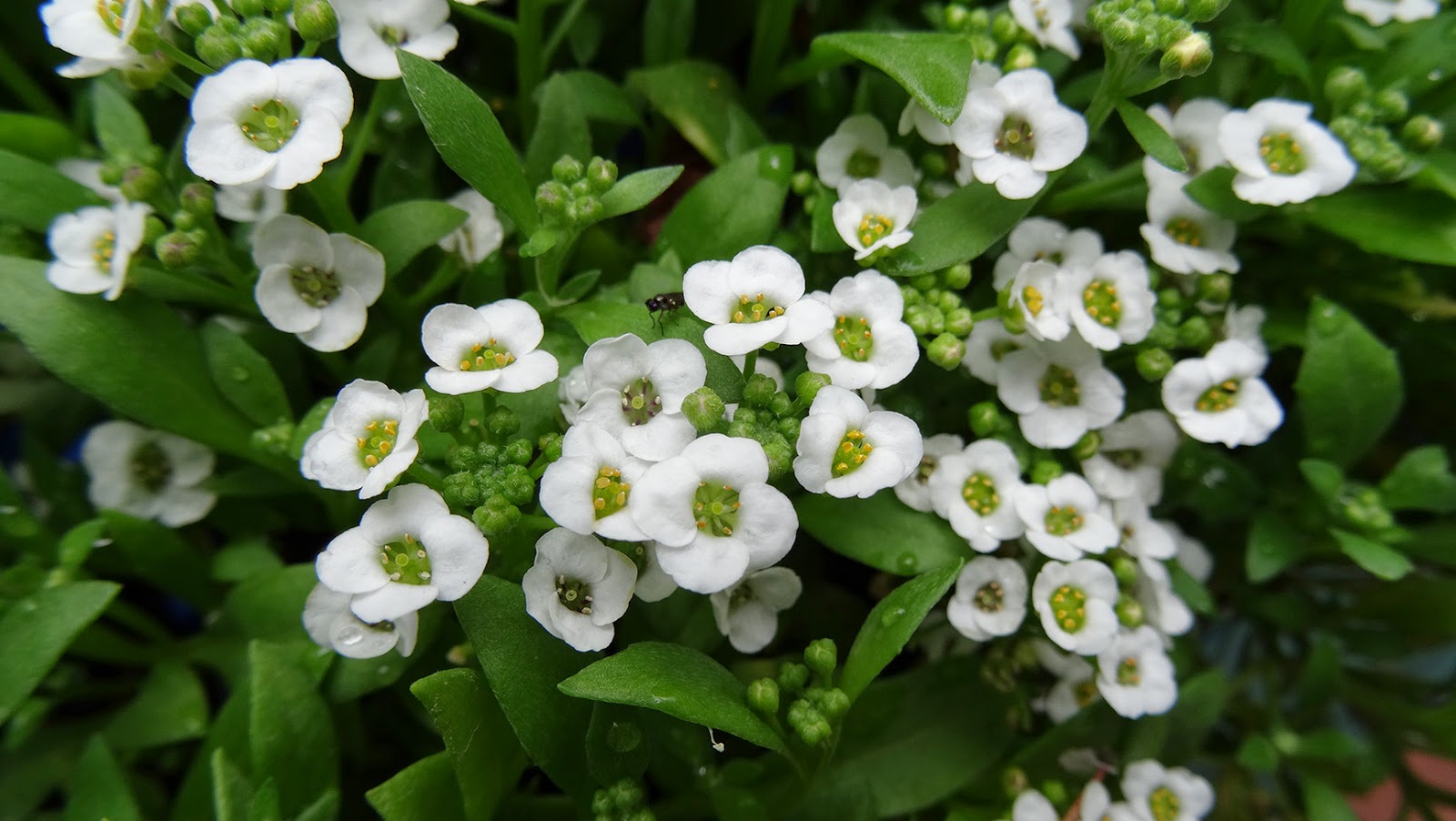
ALYSSUM

Sweet Alyssum grows as a delicate carpet of tiny flowers with a subtle, sweet scent. The low-growing foliage is covered by flowers for much of the growing season. Sweet Alyssum (Lobularia maritima) is very easy to grow, from plant or seed. It is a cool season flower that can be set out in early spring and are grown throughout the Autumn and Winter, in frost-free climates. Most varieties will fade in the heat, but rally again in Autumn.

Alyssum is an annual, but some varieties are hardy in frost-free areas and may survive for several seasons. Gardeners in USDA Hardiness Zones 7–11 may have plants that continue growing all year long, but they may be short-lived. Sometimes they self-seed so much that is seems as if the same plants are surviving, when in reality, new seedlings are filling in. 

Lobularia maritima is cultivated in gardens, with many horticultural varieties with purple or pink flowers. The plant is best planted in early spring, but requires little maintenance when growing. Although an annual, it may reseed in temperate climates It will flower more profusely if spent blooms are trimmed. When grown in gardens, it is typically used as ground-cover, as it rarely grows higher than 20 cm tall. It is also grown in cracks in paving and walls, and is especially associated with coastal locations. It prefers partial shade, and is resistant to heat and drought. Plants with darker-coloured flowers do better in cooler temperatures.

This post is part of the Floral Friday Flowers meme.

Thursday, 30 May 2019

NUTMEG PELARGONIUM

Pelargonium × fragrans is a pelargonium hybrid between Pelargonium odoratissimum and Pelargonium exstipulatum. It is in the subgenus Reniforme along with Pelargonium sidoides and Pelargonium abrotanifolium. Pelargonium comes from the Greek; Pelargos which means stork. Another name for pelargoniums is storksbills due the shape of their fruit. Fragrans refers to the fragrant leaves.

Pelargonium × fragrans, like its parent Pelargonium odoratissimum, is a small, spreading species which only grows up to 30 cm high and 60 cm wide. It has small white flowers and its leaves are waxy, green and ovate with slightly fringed edges. It has a sweet, slightly spicy, eucalyptus-like ("nutmeg") scent.

Nutmeg-Scented Pelargonium makes a nice scented border in zones 9 and up, and a great summer bloomer for other zones. In Zone 8, during a very cold winter, it dies back but returns fairly reliably. If the winter is milder, Nutmeg Pelargonium will stay evergreen and even bloom early in Zone 8.

This post is part of the Floral Friday Fotos meme.

Thursday, 21 February 2019

TREE POPPY

Romneya is a genus of flowering plants belonging to the poppy family (Papaveraceae). There are two species in genus Romneya (R. coulteri and R. trichocalyx), which was named for Irish astronomer John Thomas Romney Robinson. They are known commonly as Matilija poppies or tree poppies and are native to southern California and northern Mexico.

They are perennial subshrubs with woody stems. They may grow to a height of 2.5 meters and a width of 1 m, with the flowers up to 13 cm across. The silvery green leaves are deeply cut, with a small fringe of hairs at the margins. They are notable for their large white flowers with intense yellow centres, blooming in summer. Romneya produce the largest flowers of any members of the poppy family.

These plants prefer a warm, sunny spot and fertile soil with good water drainage. They are not easily grown but once established are difficult to remove. In the wild, they are known as "fire followers" as they can be frequently, but not exclusively, found in burned areas. Also known as "fried egg flower".

This post is part of the Floral Friday Fotos meme.

Thursday, 7 February 2019

EPIPHYLLUM

Epiphyllum crenatum is a species of cactus and one of the most important parents in creating the Epiphyllum-hybrids commonly cultivated throughout the world. It is cultivated for its beautiful diurnal flowers. It is found naturally from Mexico (Oaxaca & Chiapas) to Honduras. It is epiphytic (grows upon another plant) or lithophytic (grows on rocks) in moist or wet forests, sometimes in oak forests (1,750 m alt. or less).

It is an easily cultivated, fast-growing epiphyte. Needs compost containing plenty of humus and sufficient moisture in summer. Should not be kept under 12°C in winter. Can be grown in semi-shade or full sun. Extra light in the early spring will stimulate budding. Flowers in late spring or early summer.

This post is part of the Floral Friday Fotos meme.

Sunday, 4 November 2018

HAMSA

The hamsa (Arabic: خمسة‎ khamsah; Hebrew: חַמְסָה‬, also romanised khamsa; Berber languages: tafust) is a palm-shaped amulet popular throughout the Middle East and North Africa and commonly used in jewellery and wall hangings.

Depicting the open right hand, an image recognised and used as a sign of protection in many times throughout history, the hamsa is believed by some, predominantly Muslims, Jews and Catholics, to provide defence against the evil eye. It has been theorised that its origins lie in Ancient Egypt or Carthage (modern-day Tunisia) and may have been associated with the Goddess Tanit.

Khamsah is an Arabic word that means "five", but also "the five fingers of the hand". The Hamsa is also variously known as the Hand of Fatima after the daughter of the prophet Muhammad, the Hand of Mary, the Hand of Miriam, and the Hand of the Goddess.

This post is part of the My Sunday Best meme,
and also part of the My Sunday Photo meme,
and also part of the Photo Sunday meme.

Thursday, 25 January 2018

TUBEROSE

Polianthes tuberosa, the tuberose, is a perennial plant related to the agaves, family Agavaceae. Extracts of the extremely fragrant flower are used as a component of perfumes in perfumery. The common name derives from the Latin tuberosa, meaning swollen or tuberous in reference to its root system. Polianthes means "white-flowered" in Greek.

The tuberose is a night-blooming plant native to Mexico, as is every other known species of Polianthes. It grows in elongated spikes up to 45 cm long that produce clusters of fragrant waxy white flowers that bloom from the bottom towards the top of the spike. It has long, bright green leaves clustered at the base of the plant and smaller, clasping leaves along the stem. Epiphyllous adhesion of stamens is seen in the flower.

Members of the closely related genus Manfreda are often called "tuberoses". While once associated with funerals, it is now used in floral arrangements for other occasions, including weddings. In Indonesia, tuberose flowers are also used in cooking.

Tuberose is best cultivated in hardiness zones 8-10. It is a tropical plant, and is perennial in hardiness zones 9 to 11. Plant the bulbs in late Winter to early Spring (after the frosts have finished). Plant bulbs in succession (leaving two weeks between plantings) for a longer, staggered flowering period. The soil must be well-drained and loamy. It needs to be prepared deeply with compost or well-rotted manure. The soil must be lime-free. Full sun yields the best results. If necessary, plant in pots which can be moved to gain maximum sunshine.

This post is part of the Floral Friday Fotos meme.

Thursday, 7 December 2017

SUMMER DAISIES

Our weather continues to be fickle and changeable, with quite a bit of rain. Whenever the sun beams down, one must take the opportunity of getting out and enjoying it.

This post is part of the Floral Friday Fotos meme.
Thursday, 2 November 2017

OSTEOSPERMUM 'WHIRLIGIG"

Osteospermum is a genus of flowering plants belonging to the Calenduleae, one of the smaller tribes of the sunflower/daisy family Asteraceae. The common name is African daisy or Cape daisy. Osteospermum used to belong to the genus Dimorphotheca, but only the annual species remain in that genus now; the perennials have been placed in the genus Osteospermum.

An amazing variety of cultivars have been developed, in a stunning variety of colours. The "Whirligig" hybrids shown above have added more diversity in this versatile and prolific garden bloomer.

This post is part of the Floral Friday Fotos meme.

Thursday, 7 September 2017

WHITE CAMELLIA

“Her delight in the smallest things was like that of a child. There were days when she ran in the garden, like a child of ten, after a butterfly or a dragon-fly. This courtesan who had cost more money in bouquets than would have kept a whole family in comfort, would sometimes sit on the grass for an hour, examining the simple flower whose name she bore.” ― Alexandre Dumas fils, “La Dame aux Camélias”

This post is part of the Floral Friday Fotos meme,
and also part of the Weekend Green meme.

Thursday, 17 August 2017

VIBURNUM TINUS

Viburnum tinus (Laurustinus, laurustinus viburnum, or laurestine) is a species of flowering plant in the family Adoxaceae, native to the Mediterranean area of Europe and North Africa. Laurus signifies the leaves' similarities to bay laurel.

It is a shrub (rarely a small tree) reaching 2–7 m tall and 3 m broad, with a dense, rounded crown. The leaves are evergreen, persisting 2–3 years, ovate to elliptic, borne in opposite pairs, 4–10 cm long and 2–4 cm broad, with an entire margin. The flowers are small, white or light pink, produced from reddish-pink buds in dense cymes 5–10 cm diameter in the winter. The fragrant flowers are bisexual and pentamerous. The flowering period is from October to June (Northern Hemisphere). Pollination is by insects. The fruit is a dark blue-black drupe 5–7 mm long.

V. tinus has medicinal properties. The active ingredients are viburnin (a substance or more probably a mixture of compounds) and tannins. Tannins can cause stomach upset. The leaves when infused have antipyretic properties. The fruits have been used as purgatives against constipation. The tincture has been used lately in herbal medicine as a remedy for depression. The plant also contains iridoid glucosides.

This post is part of the Floral Friday Fotos meme.

Thursday, 16 March 2017

JIMSON WEED

Datura stramonium, known by the common names Jimson weed or datura, is a plant in the Solanaceae (nightshade) family, which is believed to have originated in the Americas, but is now found around the world. Other common names for D. stramonium include thornapple and moon flower, and it has the Spanish name Toloache.

For centuries, datura has been used as a herbal medicine to relieve asthma symptoms and as an analgesic during surgery or bonesetting. It is also a powerful hallucinogen and deliriant, which is used spiritually for the intense visions it produces. However, the tropane alkaloids which are responsible for both the medicinal and hallucinogenic properties are fatally toxic in only slightly higher amounts than the medicinal dosage, and careless use often results in hospitalisations and deaths.

Datura stramonium generally flowers throughout the summer. The fragrant flowers are trumpet-shaped, white to creamy or violet, and 6–9 cm long, and grow on short stems from either the axils of the leaves or the places where the branches fork. The calyx is long and tubular, swollen at the bottom, and sharply angled, surmounted by five sharp teeth. The corolla, which is folded and only partially open, is white, funnel-shaped, and has prominent ribs. The flowers open at night, emitting a pleasant fragrance and is fed upon by nocturnal moths.

This post is part of the Floral Friday Fotos meme.


Thursday, 9 March 2017

WILD CLEMATIS

Clematis virginiana (also known as devil's darning needles, devil's hair, love vine, traveller's joy, virgin's bower, Virginia virgin's bower, wild hops, and woodbine; syn. Clematis virginiana L. var. missouriensis (Rydb.) Palmer & Steyermark) is a vine of the Ranunculaceae (Buttercup Family) native to the United States and Canada from Newfoundland to southern Manitoba down to the Gulf of Mexico. The rationale for some of the common names is unclear, as they include examples normally applied to unrelated plants, including twining parasites (e.g. "devil's hair" for Cuscuta). The name "Love Vine" also is applied to alleged aphrodisiacs, such as Caribbean species of Cassytha, which are unrelated to Clematis, not being in the family Ranunculaceae.

This plant is an aggressively growing vine which can climb to heights of 3-6 metres by twisting leafstalks. The leaves are opposite and pinnately compound, trifoliate (3 leaflets) that have coarse unequal teeth on the margins. It produces small dull white flowers of 13 to 19mm in July into September that are faintly sweetly fragrant; normally dioecious so that there are separate staminate (male) and pistillate (female) plants. The male plants are a little showier in flower and don't bear seed.

The dry fruit is an achene with long hair as silvery gray feathery plumes attached in late August into November. It grows on the edges of the woods, moist slopes, fence rows, in thickets and on streambanks. It grows in full sun to light full shade and is very adaptable to many soils from sandy to clay, dry to draining wet, and acid to alkaline with pH range of 6.0 to 8.5. It has a deep but sparse, fibrous root system that makes it hard to transplant.Good for USDA hardiness zones of 3 to 8.

Virgin's Bower is not commonly planted in gardens and landscapes in most places. It is sold by a good number of native plant nurseries and some specialty and large conventional nurseries. What is usually sold at most every conventional nursery or garden centre is the similar sweet autumn clematis, Clematis terniflora, from Japan that is much more rampant growing, that bears heavier clouds of white flowers with a stronger fragrance, that has simple leaves not compound with 3 leaflets, that as one plant self-sows around a lot, and becomes an invasive plant when escaping cultivation in North America.

This post is part of the Floral Friday Fotos meme.


Thursday, 12 January 2017

MAGNOLIA

Magnolia is a large genus of about 210 flowering plant species in the family Magnoliaceae. It is named after French botanist Pierre Magnol. Magnolia is an ancient genus. Appearing before bees did, the flowers are theorised to have evolved to encourage pollination by beetles. To avoid damage from pollinating beetles, the carpels of Magnolia flowers are extremely tough.

Fossilised specimens of M. acuminata have been found dating to 20 million years ago, and of plants identifiably belonging to the Magnoliaceae date to 95 million years ago. Another aspect of Magnolia considered to represent an ancestral state is that the flower bud is enclosed in a bract rather than in sepals; the perianth parts are undifferentiated and called tepals rather than distinct sepals and petals. Magnolia shares the tepal characteristic with several other flowering plants near the base of the flowering plant lineage such as Amborella and Nymphaea (as well as with many more recently derived plants such as Lilium).

The natural range of Magnolia species is a disjunct distribution, with a main centre in east and southeast Asia and a secondary centre in eastern North America, Central America, the West Indies, and some species in South America.

Magnolia virginiana, is most commonly known as sweetbay magnolia, or merely sweetbay (also laurel magnolia, swampbay, swamp magnolia, whitebay, or beaver tree) and shown here. It was the first magnolia to be scientifically described under modern rules of botanical nomenclature, and is the type species of the genus Magnolia.

This post is part of the Floral Friday Fotos meme.