Thursday, 25 August 2022

CAPE DAISY

Osteospermum is a genus of flowering plants belonging to the Calenduleae, one of the smaller tribes of the sunflower/daisy family Asteraceae. The common name is African daisy or Cape daisy. Osteospermum used to belong to the genus Dimorphotheca, but only the annual species remain in that genus now; the perennials have been placed in the genus Osteospermum. Osteospermum is also closely related to the small genus Chrysanthemoides, and the resemblance is seen in species such as C. incana and C. monilifera.

This post is part of the Floral Friday Fotos meme.


Thursday, 28 July 2022

HELLEBORE

Helleborus niger, commonly called Christmas rose or black hellebore, is an evergreen perennial flowering plant in the buttercup family, Ranunculaceae. It is poisonous. Although the flowers resemble wild roses (and despite its common name), Christmas rose does not belong to the rose family (Rosaceae).

The plant is a traditional cottage garden favourite because it flowers in the depths of winter. Large-flowered cultivars are available, as are pink-flowered and double-flowered selections. It has been awarded an Award of Garden Merit (AGM).

It can be difficult to grow well; acid soil is unsuitable, as are poor, dry conditions and full sun. Moist, humus-rich, alkaline soil in dappled shade is preferable. Leaf-mould can be dug in to improve heavy clay or light sandy soils; lime can be added to 'sweeten' acid soils.

This post is part of the Floral Friday Fotos meme.


Thursday, 21 July 2022

ORCHID

Cymbidium, or boat orchids, is a genus of 52 evergreen species in the orchid family Orchidaceae. One of its first descriptions come from Olof Swartz in 1799. The name is derived from the Greek word kumbos, meaning 'hole, cavity'. It refers to the form of the base of the lip. The genus is abbreviated Cym in horticultural trade.

This genus is distributed in tropical and subtropical Asia (such as northern India, China, Japan, Malaysia, the Philippines, and Borneo) and northern Australia. The larger flowered species from which the large flowered hybrids are derived, grow at high altitudes. Cymbidiums became popular in Europe during the Victorian era. One feature that makes the plant so popular is the fact that it can survive during cold temperatures (as low as 7˚C).

This post is part of the Floral Friday Fotos meme.


Thursday, 23 June 2022

JONQUIL

Narcissus jonquilla (jonquil, rush daffodil) is a bulbous flowering plant, a species of Narcissus (daffodil) that is native to Spain and Portugal, but has now become naturalised in many other regions: France, Italy, Greece, Turkey, the former Yugoslavia, Madeira, British Columbia, Utah, Illinois, Ohio, and the southeastern United States from Texas to Maryland.

Narcissus jonquilla bears long, narrow, rush-like leaves (hence the name "jonquil", Spanish junquillo, from the Latin juncus = "rush"). In spring it bears heads of up to five scented yellow or white flowers. It is a parent of numerous varieties within Division 7 of the horticultural classification. Division 7 in the Royal Horticultural Society classification of Narcissus includes N. jonquilla and N. apodanthus hybrids and cultivars that show clear characteristics of those two species.

N. jonquilla has been cultivated since the 18th century in France as the strongest of the Narcissus species used in Narcissus Oil, a component of many modern perfumes. 

This post is part of the Floral Friday Fotos meme


Thursday, 16 June 2022

JAPONICA

Chaenomeles japonica is a species of Japanese Quince in the Rosaceae family. It is a thorny deciduous shrub that is commonly cultivated. It is shorter than another commonly cultivated species C. speciosa, growing to only about 1 m in height. The fruit is called Kusa-boke (草木瓜) in Japanese. Chaenomeles japonica is also popularly grown in bonsai. 

It is best known for its colourful spring flowers of red, white or pink. It produces apple-shaped fruit that are a golden-yellow colour containing red-brown seeds. The fruit is edible, but hard and astringent-tasting, unless bletted. The fruit is occasionally used in jelly and pie making as an inferior substitute for its cousin, the true quince, Cydonia oblonga.

This post is part of the Floral Friday Fotos meme.


Thursday, 9 June 2022

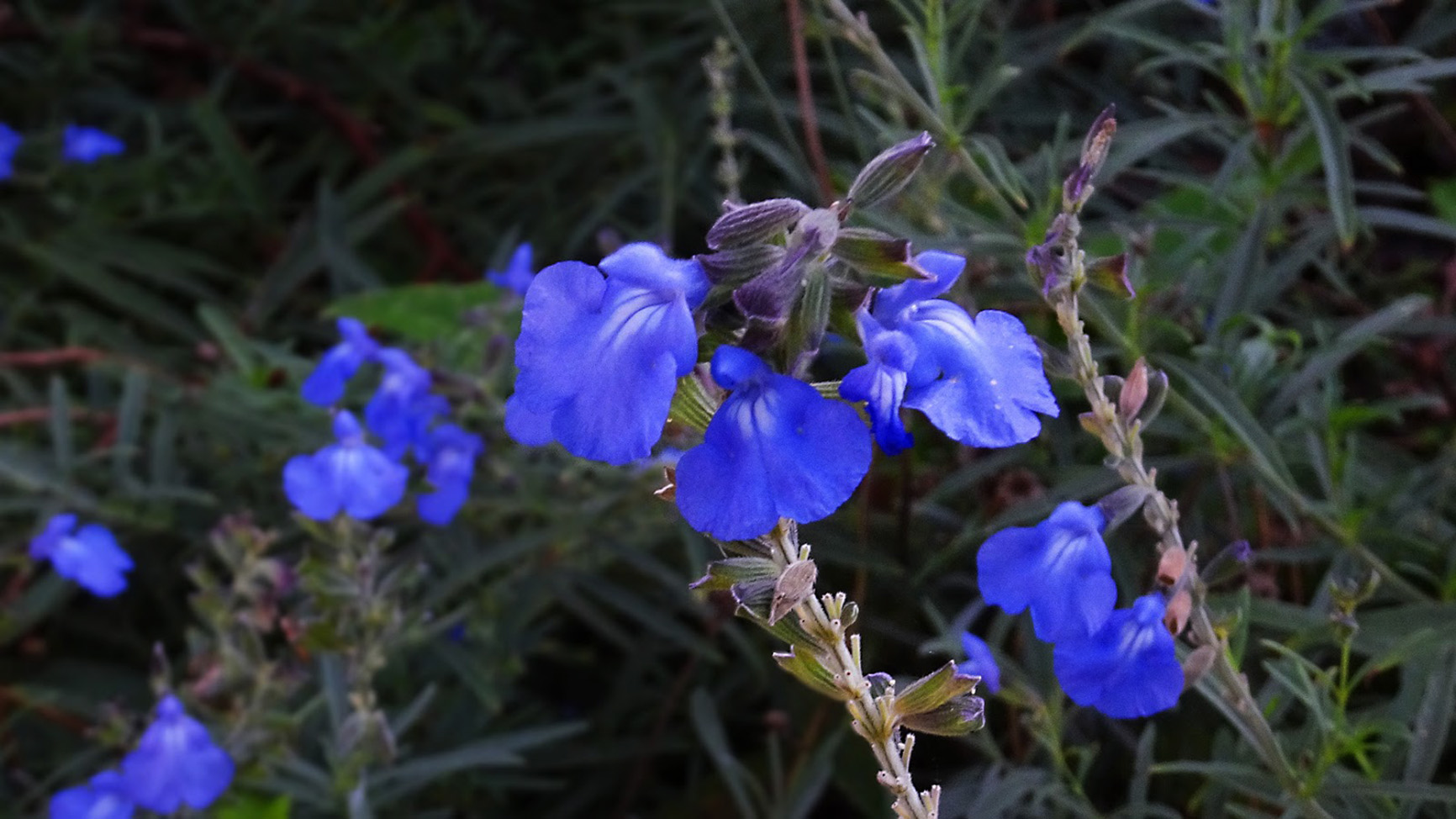
AZURE SAGE

Salvia azurea, the azure blue sage, azure sage, blue sage or prairie sage, is a herbaceous perennial in the genus Salvia, family Lamiaceae, that is native to Central and Eastern North America. Its thin, upright stems can grow to 1.8 m tall, with narrow, pointed, smooth-edged to serrated, furry to smooth green leaves, connected to their stems by petioles to 1.0 cm long. There are no basal leaves.

The blue (rarely white), flowers  nearly 6.4 to 12.7 mm long, appear summer to autumn near the ends of their branched or unbranched spikes; their calyxes are tubular or bell-shaped and furry. Two varieties are Salvia azurea var. azurea (azure sage) and Salvia azurea var. grandiflora (pitcher sage). It is found on the wild on roadsides, glades, fields and pastures.

This post is part of the Floral Friday Fotos meme.


Thursday, 2 June 2022

PETREA

Petrea is a genus of evergreen flowering vines native to Mexico and Central America. They have rough-textured leaves, hence the common name "sandpaper vine". It looks somewhat similar to a tropical Wisteria.

Shown here is Petrea volubilis. Carolus Linnaeus named Petrea in honour of Robert James Petre, 8th Baron Petre of Ingatestone Hall in Essex. Petre was a patron of botany.

This post is part of the Floral Friday Fotos meme.