Showing posts with label evergreen. Show all posts

Thursday, 2 June 2022

PETREA

Petrea is a genus of evergreen flowering vines native to Mexico and Central America. They have rough-textured leaves, hence the common name "sandpaper vine". It looks somewhat similar to a tropical Wisteria.

Shown here is Petrea volubilis. Carolus Linnaeus named Petrea in honour of Robert James Petre, 8th Baron Petre of Ingatestone Hall in Essex. Petre was a patron of botany.

This post is part of the Floral Friday Fotos meme.


Thursday, 7 April 2022

CHINESE LANTERN

Abutilon or 'Chinese lanterns' are closely related to hibiscus, and most of the hundred or so species have pendulous, hibiscus-like flowers. Cultivars produced by hybridising some of the South American abutilons have all been placed in one group known as Abutilon x hybridum, and these are the ones most commonly grown in Australian gardens.

They have a wispy, delicate form and colourful, lantern-shaped flowers. For gardeners who prefer plants with a more dense habit, new compact varieties are also available. Another popular abutilon is Abutilon megapotamicum, which is a prostrate or ground covering species with small orange flowers. Abutilon are evergreen shrubs with attractive maple-like leaves and an open, pendulous habit. They grow to about 2-3 metres tall.

Flowers in the Southern Hemisphere are produced in September to December, but they spot flower at other times. Flower colours include white, pink, red, yellow, orange and salmon. These plants grow well in most parts of Australia, except for the very cold mountain zones. In inland areas be sure to water well and keep protected with mulch. In hot inland climates abutilons appreciate some light shade.

This post is part of the Floral Friday Fotos meme.


Thursday, 17 March 2022

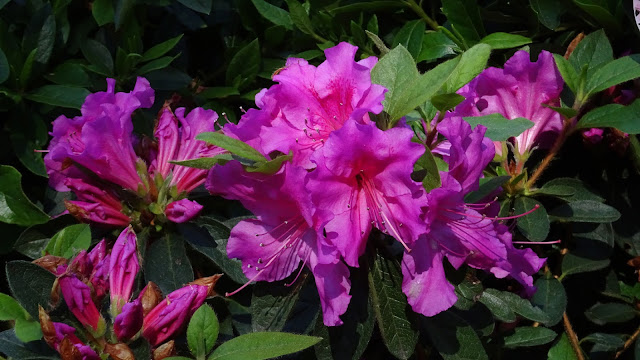
EVERGREEN AZALEA

Rhododendron is a genus of 500 to 900 species in the Ericaceae family and includes both of what we commonly call rhododendrons and azaleas. Most are evergreen but some are deciduous. Genus name comes from the Greek words rhodon meaning rose and dendron meaning tree. Transferred from the Greek name for Nerium oleander.

They originate mostly from the Northern Hemisphere with high concentrations in western China, the Himalayas and Myanmar (Burma). They are grown for their showy spring flowers and in the case of evergreen types for their attractive winter foliage. True rhododendrons have 10 stamens in a flower and azaleas have only 5. Much hybridisation has resulted in a great number of hybrid cultivars. Of note to gardeners in cool temperate areas are the large and small leaved evergreen rhododendrons and the evergreen and deciduous azaleas.

Evergreen azaleas develop as multi-stemmed plants from the ground and usually grow 3-5 feet tall. They retain their leaves throughout the year and are not as winter hardy as the deciduous azaleas. In cold winters flower buds may be frozen resulting in reduced or no flowering and foliage may winter burn (turn brown and be killed). Colour range is mostly from white to pink, red, lavender and purple.

'Conlec', commonly sold under the trade name of AUTUMN ROYALTY, is an evergreen azalea (Encore Series) that features large single purplish-pink flowers. It typically matures over time in an upright, dense, rounded form to 1.5 m tall and to 1.2 m wide. Large, open funnel-shaped flowers (to 10 cm diameter) bloom singly in early midseason (late April-May). A lesser repeat bloom may occur in late summer to fall. Matte green leaves (to 16 cm long) are evergreen. Parents are R. 'Georgia Giant' x R. oldhamii 'Fourth of July.' U. S. Plant Patent PP10,580 was issued on September 1, 1998.

This post is part of the Floral Friday Fotos meme


Thursday, 2 January 2020

WARATAH

Telopea speciosissima or the “waratah” is a native Australian plant with spectacular flowers. Robert Brown (1773-1858) named the genus Telopea in 1810 from specimens collected in the Blue Mountains, west of Sydney. Sir James Smith (1759-1828), a noted botanist and founder of the Linnaean Society in England, wrote in 1793: 'The most magnificent plant which the prolific soil of New Holland affords is, by common consent, both of Europeans and Natives, the Waratah. It is moreover a favourite with the latter, upon account of a rich honeyed juice which they sip from its flowers'.

The generic name Telopea is derived from the Greek 'telopos', meaning 'seen from afar', and refers to the great distance from which the crimson flowers are discernible. The specific name speciosissima is the superlative of the Latin adjective 'speciosus', meaning 'beautiful' or 'handsome'. 'Waratah', the Aboriginal name for the species, was adopted by early settlers at Port Jackson.

Telopea is an eastern Australian genus of four species. Two are confined to New South Wales, one to Tasmania and one extends from eastern Victoria into New South Wales. Telopea belongs to the family, Proteaceae, which is predominantly Australian and southern African. The Waratah is a stout, erect shrub which may grow to 4 metres. The dark green leathery leaves, 13-25 cm in length, are arranged alternately and tend to be coarsely toothed. The flowers are grouped in rounded heads 7 to 10 cm in diameter surrounded by crimson bracts, about 5 to 7 cm long. It flowers from September to November and nectar-seeking birds act as pollinators. Large winged seeds are released when the brown leathery pods split along one side.

The species is fairly widespread on the central coast and adjoining mountains of New South Wales, occurring from the Gibraltar Range, north of Sydney, to Conjola in the south. It grows mainly in the shrub understorey in open forest developed on sandstone and adjoining volcanic formations, from sea level to above 1000 metres in the Blue Mountains. Soils within its range tend to be sandy and low in plant nutrients. Rainfall is moderately high. Waratah plants resist destruction by bushfires, a natural element of their habitat, by regenerating from the rootstock. Flowering recommences two years after a moderate fire.

The Waratah is a spectacular garden subject in suitable soil and climate; it flowers prolifically and tends to be long-lived. The Waratah occurs naturally in at least ten national parks in the geological formation, know as the Sydney Basin. Brisbane Water, Dharug and Macquarie Pass National Parks are among the areas where this species is conserved. Waratahs are cultivated north of Sydney and in the Dandenong Ranges, Victoria. They are grown in Israel, New Zealand and Hawaii for the cut flower trade. It was introduced to England in 1789 but cannot survive English winters out of doors except in the south-west coastal regions, and it rarely flowers in glasshouses. It is also cultivated in California.

This post is part of the Floral Friday Fotos meme.