Showing posts with label Proteaceae. Show all posts

Thursday, 13 April 2023

WARATAH

Waratah (Telopea) is an Australian-endemic genus of five species of large shrubs or small trees, native to the southeastern parts of Australia (New South Wales, Victoria and Tasmania). The most well-known species in this genus is Telopea speciosissima, which has bright red flowers and is the NSW state emblem.
The waratah is a member of the plant family Proteaceae, a family of flowering plants distributed in the Southern Hemisphere. The key diagnostic feature of Proteaceae is the inflorescence, which is often very large, brightly coloured and showy, consisting of many small flowers densely packed into a compact head or spike. Species of waratah boast such inflorescences ranging from 6–15 cm in diameter with a basal ring of coloured bracts.
The leaves are spirally arranged, 10–20 cm long and 2–3 cm broad with entire or serrated margins. The name waratah comes from the Eora Aboriginal people, the original inhabitants of the Sydney area.

This post is part of the Floral Friday Fotos meme


Thursday, 8 September 2022

ISOPOGON

This post is part of the Floral Friday Fotos meme

Isopogon formosus or Rose Cone Flower is a shrub in the Proteaceae family that is endemic to areas near Albany and Esperance in Western Australia. In occurs naturally in heathland and woodland areas. It has an erect or bushy form and is usually between 1.5 and 2 metres high. The pink flowers appear from mid winter to early summer. Rounded "drumsticks" containing the seeds appear later, formed from the old flower parts. The plant's leaves are divided, narrow, terete and about 5 cm long.


Thursday, 16 January 2020

LEUCADENDRON

Leucadendron is a genus of about 80 species of flowering plants in the family Proteaceae, endemic to South Africa, where they are a prominent part of the fynbos ecoregion and vegetation type. Species in the genus Leucadendron are small trees or shrubs that are erect or creeping. Most species are shrubs that grow up to 1 m tall, some to 2 or 3 m. A few grow into moderate-sized trees up to 16 m tall. All are evergreen.

The leaves are largely elliptical, sometimes needle-like, spirally arranged, simple, entire, and usually green, often covered with a waxy bloom, and in the case of the Silvertree, with a distinct silvery tone produced by dense, straight, silky hairs. This inspired the generic name Leucadendron, which literally means "white tree". The flowers are produced in dense inflorescences at the branch tips; plants are dioecious, with separate male and female plants. The seed heads, or infructescences, of Leucadendron are woody cone-like structures. This gave rise to their generic common name cone-bush. The cones contain numerous seeds. The seed morphology is varied and reflects subgeneric groupings within the genus.

Shown here is Leucadendron salignum 'Fireglow'. It has red-tipped, green foliage, with masses of red flower bracts from early autumn to early spring. It prefers a well drained, acidic soil and will tolerate light frosts, as well as coastal conditions. Prune after flowering and fertilise with an acidic fertiliser sparingly. This plant has a moderate water requirement once established. These flowers bracts make excellent cut flowers. The plants compact nature makes it ideal for small hedges, general landscaping, and looks fantastic in decorative pots.

This post is part of the Floral Friday Fotos meme.

Thursday, 2 January 2020

WARATAH

Telopea speciosissima or the “waratah” is a native Australian plant with spectacular flowers. Robert Brown (1773-1858) named the genus Telopea in 1810 from specimens collected in the Blue Mountains, west of Sydney. Sir James Smith (1759-1828), a noted botanist and founder of the Linnaean Society in England, wrote in 1793: 'The most magnificent plant which the prolific soil of New Holland affords is, by common consent, both of Europeans and Natives, the Waratah. It is moreover a favourite with the latter, upon account of a rich honeyed juice which they sip from its flowers'.

The generic name Telopea is derived from the Greek 'telopos', meaning 'seen from afar', and refers to the great distance from which the crimson flowers are discernible. The specific name speciosissima is the superlative of the Latin adjective 'speciosus', meaning 'beautiful' or 'handsome'. 'Waratah', the Aboriginal name for the species, was adopted by early settlers at Port Jackson.

Telopea is an eastern Australian genus of four species. Two are confined to New South Wales, one to Tasmania and one extends from eastern Victoria into New South Wales. Telopea belongs to the family, Proteaceae, which is predominantly Australian and southern African. The Waratah is a stout, erect shrub which may grow to 4 metres. The dark green leathery leaves, 13-25 cm in length, are arranged alternately and tend to be coarsely toothed. The flowers are grouped in rounded heads 7 to 10 cm in diameter surrounded by crimson bracts, about 5 to 7 cm long. It flowers from September to November and nectar-seeking birds act as pollinators. Large winged seeds are released when the brown leathery pods split along one side.

The species is fairly widespread on the central coast and adjoining mountains of New South Wales, occurring from the Gibraltar Range, north of Sydney, to Conjola in the south. It grows mainly in the shrub understorey in open forest developed on sandstone and adjoining volcanic formations, from sea level to above 1000 metres in the Blue Mountains. Soils within its range tend to be sandy and low in plant nutrients. Rainfall is moderately high. Waratah plants resist destruction by bushfires, a natural element of their habitat, by regenerating from the rootstock. Flowering recommences two years after a moderate fire.

The Waratah is a spectacular garden subject in suitable soil and climate; it flowers prolifically and tends to be long-lived. The Waratah occurs naturally in at least ten national parks in the geological formation, know as the Sydney Basin. Brisbane Water, Dharug and Macquarie Pass National Parks are among the areas where this species is conserved. Waratahs are cultivated north of Sydney and in the Dandenong Ranges, Victoria. They are grown in Israel, New Zealand and Hawaii for the cut flower trade. It was introduced to England in 1789 but cannot survive English winters out of doors except in the south-west coastal regions, and it rarely flowers in glasshouses. It is also cultivated in California.

This post is part of the Floral Friday Fotos meme.

Thursday, 21 November 2019

PINCUSHION PROTEA

Leucospermum (Pincushion, Pincushion Protea or Leucospermum) is a genus of about 50 species of flowering plants in the family Proteaceae, native to Zimbabwe and South Africa, where they occupy a variety of habitats, including scrub, forest, and mountain slopes. They are evergreen shrubs (rarely small trees) growing to 0.5-5 m tall. The leaves are spirally arranged, tough and leathery, simple, linear to lanceolate, 2-12 cm long and 0.5-3 cm broad, with a serrated margin or serrated at the leaf apex only. The flowers are produced in dense inflorescences, which have large numbers of prominent styles, which inspires the name. 

The genus is closely related in evolution and appearance to the Australian genus Banksia. Shown here is a Leucospermum patersonii hybrid. An excellent ornamental hardy shrub for most well-drained soils and full sun positions. It is a relatively fast growing landscape shrub for coastal or inland gardens. The two-tone orange-red flowers make a great long stemmed cut flower, and is thus grown commercially for this purpose.

This post is part of the Floral Friday Fotos meme.

Thursday, 14 November 2019

TREE GREVILLEA

Grevillea robusta, commonly known as the southern silky oak or silky oak, or Australian silver oak, is the largest species in the genus Grevillea of the family Proteaceae. It is not closely related to the true oaks, Quercus. It is a native of eastern coastal Australia, in riverine, subtropical and dry rainforest environments receiving more than 1,000 mm per year of average rainfall.

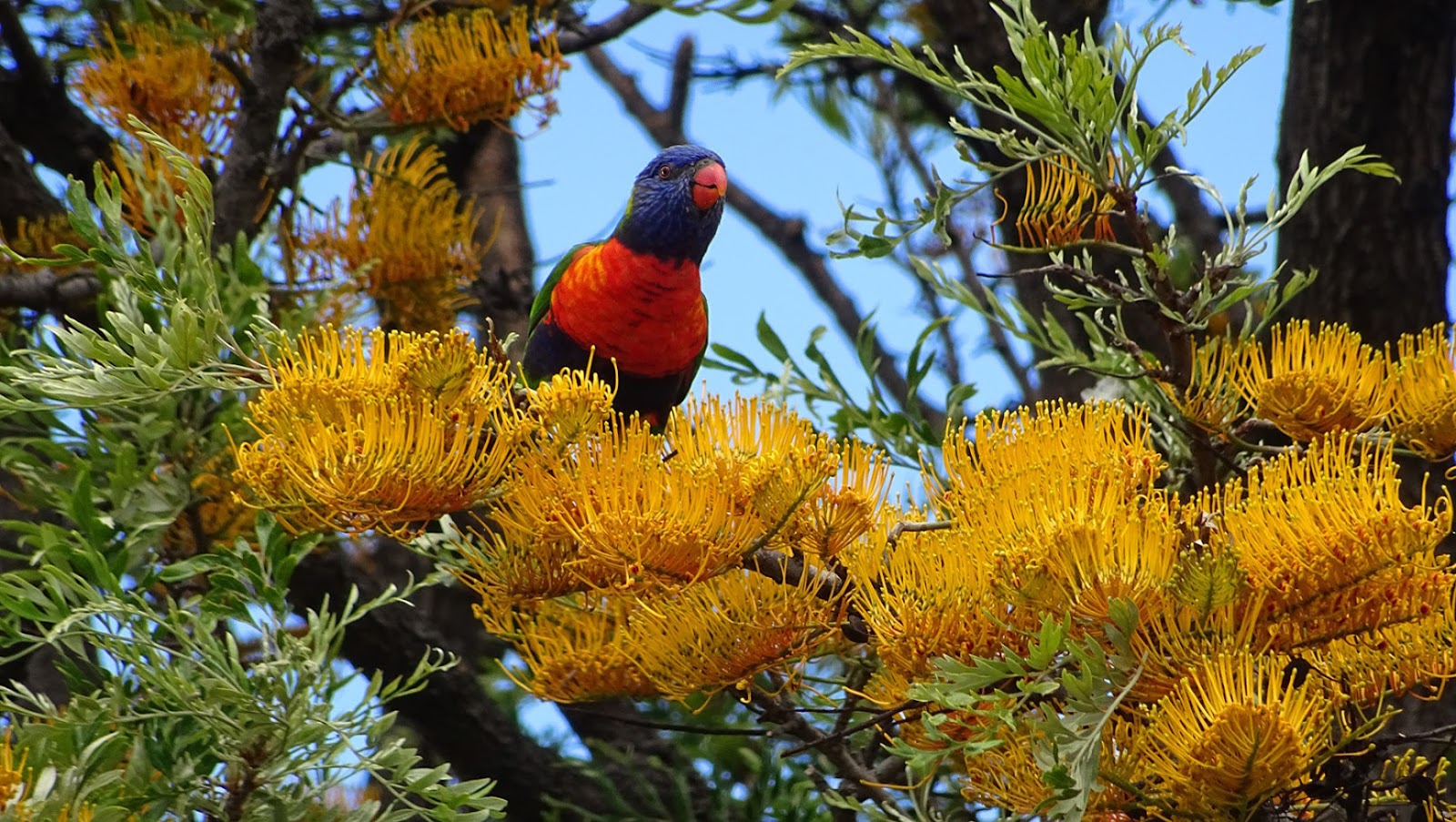
It is a fast-growing evergreen tree, between 18–35 m tall, with dark green delicately dented bipinnatifid leaves reminiscent of a fern frond. It is the largest plant in the Grevillea genus, the trunk reaching diameter in excess of 1 m. The leaves are generally 15–30 cm long with greyish white or rusty undersides. Its flowers are golden-orange bottlebrush-like blooms, between 8–15 cm long, in the spring, on a 2–3 cm long stem and are used for honey production. Native birds (like the Rainbow Lorikeet here) feed on the nectar.

Like others of its genus, the flowers have no petals, instead they have a long calyx that splits into 4 lobes. The seeds mature in late winter to early spring, fruiting on dark brown leathery dehiscent follicles, about 2 cm long, with one or two flat, winged seeds. Before the advent of aluminium, the timber from this tree was widely used for external window joinery as it is resistant to rotting. It was also popular for making furniture. There are severe restrictions on the harvesting of this tree now as the number of trees became depleted. Silky Oak is a valuable timber and was one of Australia’s best known cabinet timbers.It is the best tree which can be used for fencing and it is one of the fastest growing trees.

This post is part of the Floral Friday Fotos meme.

Thursday, 31 May 2018

PROTEA

Cold hardiness and beautiful pink and black flowers are the hallmarks of the hybrid Protea, 'Pink Ice.' A cross between the South African natives, mink protea (Protea neriifolia) and stink-leaf sugarbush (P. susannae), this evergreen is an upright to loosely rounded shrub that blooms in Autumn and Winter.

Its stellar blooms are beautiful when cut and last for two to three weeks in a vase. The narrow, oval foliage of this shrub is medium green with a leathery, hard texture. When Autumn and Winter days shorten and temperatures grow cooler, the leaf edges blush rosy pink. Each blossom resembles a torch with hundreds of magenta-rose bracts. The tips of the bracts are edged with feathery burgundy black hairs.

This Protea is among the easiest to grow. It tolerates slightly acid and alkaline soils as well as climates that are wet in winter and dry in summer, or dry in winter and wet in summer. For best performance, plant it in full sun and alkaline soil that is moderately infertile. Soil must be fast-draining and porous; moist soils encourage fungal diseases. Amend loam and clay soils with grit and coarse organic matter to improve aeration and drainage. Do not fertilise, especially with phosphorus which causes proteas to falter.

Plant this showy shrub in a prominent location to show off its magnificent flowers. All proteas are short-lived surviving 10 to 15 years at most. Take stem cuttings from older plants to replace older, failing specimens. Trim spent flowers off in spring to encourage fuller growth and more blooms by early winter.

This post is part of the Floral Friday Fotos meme.

Thursday, 6 July 2017

GREVILLEA

Grevillea is a diverse genus of about 360 species of evergreen flowering plants in the protea family Proteaceae, native to rainforest and more open habitats in Australia, New Guinea, New Caledonia, Indonesia and Sulawesi. It was named in honour of Charles Francis Greville. The species range from prostrate shrubs less than 50 cm tall to trees 35 m tall. Common names include grevillea, spider flower, silky oak and toothbrush plant. Closely related to the genus Hakea, the genus gives its name to the subfamily Grevilleoideae.

Grevillea 'Molly' is a very popular grevillea cultivar which has been planted widely in Australia and other countries. It is a shrub that grows to 1.5 to 2 metres in height and up to 1.5 to 2 metres width and has attractive divided leaves The red inflorescences are about 15 cm long by 9 cm wide.

This post is part of the Floral Friday Fotos meme.


Thursday, 29 June 2017

HEATH-LEAVED BANKSIA

Banksia ericifolia, the heath-leaved banksia (also known as the lantern banksia or heath banksia), is a species of woody shrub of the family Proteaceae native to Australia. It grows in two separate regions of Central and Northern New South Wales east of the Great Dividing Range. Well known for its orange or red autumn inflorescences, which contrast with its green fine-leaved heath-like foliage, it is a medium to large shrub that can reach 6 m high and wide, though is usually half that size. In exposed heathlands and coastal areas it is more often 1–2 m.

Banksia ericifolia was one of the original Banksia species collected by Joseph Banks around Botany Bay in 1770 and was named by Carl Linnaeus the Younger, son of Carl Linnaeus, in 1782. A distinctive plant, it has split into two subspecies: Banksia ericifolia subspecies ericifolia of the Sydney region and Banksia ericifolia subspecies macrantha of the New South Wales Far North Coast which was recognised in 1996.

Banksia ericifolia has been widely grown in Australian gardens on the east coast for many years, and is used to a limited extent in the cut flower industry. Compact dwarf cultivars such as Banksia 'Little Eric' have become more popular in recent years with the trend toward smaller gardens. The dwarf form is shown here.

This post is part of the Floral Friday Fotos meme.


Thursday, 25 May 2017

WHITE & PINK PROTEA

Protea is both the botanical name and the English common name of a genus of South African flowering plants, sometimes also called sugarbushes (Afrikaans: suikerbos). In local tradition, the Protea flower represents change and hope.

The family Proteaceae to which proteas belong is an ancient one among angiosperms. Evidence from pollen fossils suggest Proteaceae ancestors grew in Gondwana, in the Upper Cretaceous, 75-80 million years ago. The Proteaceae are divided into two subfamilies: the Proteoideae, best represented in southern Africa, and the Grevilleoideae, concentrated in Australia and South America and the other smaller segments of Gondwana that are now part of eastern Asia. Africa shares only one genus with Madagascar, whereas South America and Australia share many common genera — this indicates they separated from Africa before they separated from each other.

This post is part of the Floral Friday Fotos meme,
and also part of the Friday Photo Journal.


Thursday, 13 October 2016

WARATAHS & CHRYSANTHEMUMS

Waratah (Telopea) is an Australian-endemic genus of five species of large shrubs or small trees, native to the southeastern parts of Australia (New South Wales, Victoria and Tasmania). The most well-known species in this genus is Telopea speciosissima, which has bright red flowers and is the NSW state emblem.

The waratah is a member of the plant family Proteaceae, a family of flowering plants distributed in the Southern Hemisphere. The key diagnostic feature of Proteaceae is the inflorescence, which is often very large, brightly coloured and showy, consisting of many small flowers densely packed into a compact head or spike. Species of waratah boast such inflorescences ranging from 6–15 cm in diameter with a basal ring of coloured bracts. The leaves are spirally arranged, 10–20 cm long and 2–3 cm broad with entire or serrated margins. The name waratah comes from the Eora Aboriginal people, the original inhabitants of the Sydney area.

Chrysanthemums, sometimes called mums or chrysanths, are flowering plants of the genus Chrysanthemum in the family Asteraceae. They are native to Asia and northeastern Europe. Most species originate from East Asia and the centre of diversity is in China. There are countless horticultural varieties and cultivars. Shown here is a green spider chrysanthemum hybrid.

This post is part of the Floral Friday Fotos meme.


Thursday, 28 July 2016

BANKSIA COCCINEA

Banksia coccinea, commonly known as the scarlet banksia, waratah banksia or Albany banksia, is an erect shrub or small tree in the family Proteaceae. Endemic to south west Western Australia, it occurs from Denmark to the Stokes National Park, and north to the Stirling Range, growing on white or grey sand in shrubland, heath or open woodland.

Reaching up to 8 m in height, it is a single-stemmed plant that has oblong leaves, which are 3–9 cm long and 2–7 cm wide. The prominent red and white flower spikes appear mainly in the spring. As they age they develop small follicles that store seeds until opened by fire. Though widely occurring, it is highly sensitive to dieback and large populations of plants have succumbed to the disease. Collected and described by Robert Brown in the early 19th century, Banksia coccinea appears to be most closely related to Banksia speciosa and B. baxteri.

Banksia coccinea plants are killed by bushfire, and regenerate from seed. The flowers attract nectar- and insect-feeding birds, particularly honeyeaters, and a variety of insects. Widely considered one of the most attractive Banksia species, B. coccinea is a popular garden plant and one of the most important Banksia species for the cut flower industry; it is grown commercially in several countries including Australia, South Africa, Canada, the United States, New Zealand and Israel. In cultivation, B. coccinea grows well in a sunny location on well-drained soil, but it cannot survive in areas with humid or wet summers.

This post is part of the Floral Friday Fotos meme.

Thursday, 17 December 2015

PROTEAS

Protea is both the botanical name and the English common name of a genus of South African flowering plants, sometimes also called sugarbushes (Afrikaans: suikerbos). The genus Protea was named in 1735 by Carl Linnaeus after the Greek god Proteus, who could change his form at will, because proteas have such a wide variety of forms.

The Proteaceae family to which proteas belong is an ancient one. Its ancestors grew in Gondwana, 300 million years ago. Proteaceae is divided into two subfamilies: the Proteoideae, best represented in southern Africa, and the Grevilleoideae, concentrated in Australia and South America and the other smaller segments of Gondwana that are now part of eastern Asia. Africa shares only one genus with Madagascar, whereas South America and Australia share many common genera — this indicates they separated from Africa before they separated from each other.

Most proteas occur south of the Limpopo River. However, Protea kilimanjaro is found in the chaparral zone of Mount Kenya National Park. 92% of the species occur only in the Cape Floristic Region, a narrow belt of mountainous coastal land from Clanwilliam to Grahamstown, South Africa. The extraordinary richness and diversity of species characteristic of the Cape Flora is thought to be caused in part by the diverse landscape where populations can become isolated from each other and in time develop into separate species.

This post is part of the Floral Friday Fotos meme.


Friday, 30 October 2015

FRIDAY GREENS #44 - LEUCADENDRON

Welcome to this meme active every Friday. The theme is "Friday Greens" and you can post images, art, photos where the predominant colour is GREEN!
GREEN is the colour between blue and yellow in the spectrum; coloured like grass or emeralds.

Leucadendron laureolum x salignum 'Inca Gold' is a spectacular golden colour in winter. It is ideal for low maintenance, low water use gardens. Great for cut flowers.
This post is also part of the Floral Friday Fotos meme.

I appreciate your comments, and please add a link back to this page from your own Friday Greens blog post.
The meme is only as successful as you make it be! Please add your own GREEN post using the Linky tool below:

Thursday, 29 October 2015

KING PROTEA

The king protea (Protea cynaroides) is a flowering plant. It is a distinctive member of the family Proteaceae, having the largest flower head in the genus. The species is also known as giant protea, honeypot or king sugar bush. It is widely distributed in the southwestern and southern parts of South Africa in the fynbos region.

The king protea is the national flower of South Africa. It also is the flagship of the The Protea Atlas Project, run by the South African National Botanical Institute. The king protea has several colour forms and horticulturists have recognised 81 garden varieties, some of which have injudiciously been planted in its natural range. In some varieties the pink of the flower and red borders of leaves are replaced by a creamy yellow.

This unusual flower has a long vase life in flower arrangements, and makes for an excellent dried flower. Protea cynaroides is adapted to survive wildfires by its thick underground stem, which contains many dormant buds; these will produce the new growth after the fire.

This post is part of the Floral Friday Fotos meme.